The Empress Tarot Card Meaning — Abundance and Creation
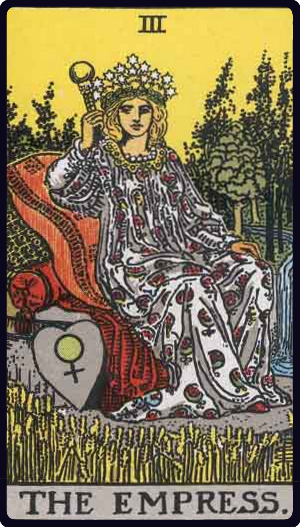
The Empress (card 3) — symbolizes abundance, fertility, creativity, and motherhood. She is the Divine Mother bringing growth and nurturing energy.
1. About The Empress
The Empress is card 3 of the Major Arcana. In the Rider-Waite-Smith image she sits on cushions in an open landscape, wearing a crown of stars and a flowing robe patterned with pomegranates. A heart-shaped shield carrying the symbol of Venus leans beside her, ripe wheat grows in front of her, and a forest and waterfall fill the background. It is one of the few Major Arcana scenes that feels relaxed rather than formal.
Modern readers associate her with growth, care and abundance: things that develop because they are tended. She can describe a creative project, a home, a pregnancy in the broad sense of something being "carried", or simply the comfort of a period where effort turns into visible results.
2. Where The Empress Comes From
- A ruler first. In the 15th-century Italian decks the Empress was a crowned, enthroned figure, part of a sequence of worldly powers alongside the Emperor and the Pope. Her shield usually carried an eagle, the heraldic emblem of the Holy Roman Empire, and she held a sceptre.
- Esoteric reinterpretation. In the 18th century writers such as Antoine Court de Gébelin and Etteilla began reading tarot as a source of ancient wisdom. They associated the Empress with Isis and with Kabbalistic ideas, moving her away from politics and toward symbolism.
- The garden Empress. The Rider-Waite-Smith version replaced the eagle with the sign of Venus and set her in nature: wheat, trees and running water. This is the version most people know, and it is the source of her modern "mother nature" reading.
The change is significant. Earlier players would have seen authority and dynasty in this card. Today's readers usually see nurture and creativity. Both readings are still useful: she represents power, but a kind that works through sustaining rather than commanding.
3. Reading the Symbols on the Card
| Symbol | Common reading |
|---|---|
| Crown of twelve stars | Often linked to the twelve months or zodiac signs, a sense of natural cycles. |
| Shield with the Venus symbol | Love, beauty and the arts, replacing the imperial eagle of earlier decks. |
| Ripe wheat | Harvest: results that come from planting and patience. |
| Forest and waterfall | Life and emotion flowing freely; growth that is not forced. |
| Pomegranates on the robe | A traditional symbol of fertility and plenty, echoing the pomegranates on the High Priestess's veil. |
4. Upright Meaning by Area of Life
🌾 Growth
Something you started is beginning to show results.
🤲 Care
Looking after people, projects or yourself with attention.
🎨 Creativity
Making things: art, food, gardens, businesses.
🛋 Comfort
Enjoying the senses, home and rest without guilt.
| Area | Upright | Reversed |
|---|---|---|
| Love | Warmth, affection and a relationship that feels nourishing; attention to physical closeness and comfort. | Smothering, or giving care with conditions attached; feeling taken for granted. |
| Work | Creative output, a project that needs nurturing, or roles centred on care and design. | Creative block, or so much caring for others that your own work stalls. |
| Money | Steady growth; investing time in something that will pay off gradually. | Overspending on comfort, or neglecting practical matters. |
| Wellbeing | Rest, good food, time outdoors. | Neglecting your own needs while tending everyone else's. |
5. The Reversed Empress
Waite's own 1910 notes are surprisingly mixed: for the upright card he included "fruitfulness, action, initiative" but also "difficulty, doubt, ignorance", while for the reversed card he gave "light, truth, the unravelling of involved matters" alongside "vacillation". Modern readers have mostly settled on a simpler reversed meaning: care out of balance. That can mean giving too much and feeling drained, holding on to people or projects that need space to grow on their own, or losing touch with the physical side of life such as sleep, food and time outside. It is a prompt to restore balance rather than a sign of loss.
6. Worked Examples
Example 1: A stalled creative project
A writer asks why a novel has stopped moving and draws the Empress reversed in the "obstacle" position. A reading might focus on conditions rather than talent: the writer has been filling every hour with other commitments, so the project has had no "soil" to grow in. The practical suggestion is to protect regular time for it.
Example 2: Moving in together
A couple asks about setting up a home. The Empress upright in the outcome position is usually read as a welcoming, comfortable environment if both put care into it. It does not promise a smooth path; it describes what the home could feel like.
Example 3: Caring for a parent
Someone looking after an elderly parent draws the Empress beside the Ten of Wands. Readers would likely see the card as the caring role itself and the Ten of Wands as the weight of doing it alone, which points toward asking for help or sharing the load.
7. Common Card Pairings
- Empress + Emperor: nurture and structure together; a household, team or project that needs both warmth and rules.
- Empress + Star: recovery and gentle growth after a hard period.
- Empress + Lovers: affection and attraction with a strong physical side.
- Empress + High Priestess: an idea taking shape in private before it is ready to show.
8. Common Misunderstandings
- "The Empress means pregnancy." Some readers use it that way, but the card describes growth and nurture in general. A tarot card cannot confirm a pregnancy; that is a question for a medical test.
- "It only applies to women or mothers." The qualities it describes, such as care, creativity and patience, belong to everyone.
- "Abundance means money is coming." The abundance on the card is a harvest, which depends on planting. It points to results of effort over time, not windfalls.
- "She is the gentle opposite of the Emperor." In the earliest decks she was a political ruler in her own right. Gentleness is one side of her, not all of her.
9. Frequently Asked Questions
❓ What is the Empress in a career reading?
She tends to point to work that grows through attention, such as design, teaching, hospitality, care professions or a small business. For more on work questions see our career tarot guide.
❓ Why does the Empress have the Venus symbol?
The Rider-Waite-Smith deck replaced the older imperial eagle with the sign of Venus, linking the card to love, beauty and fertility rather than to political power.
❓ Is the Empress a good card in a love reading?
Usually she describes warmth and affection. Whether the relationship works depends on many things the card does not show. See Tarot for Love for how readers combine cards in relationship spreads.
❓ What does the reversed Empress ask me to do?
Most often to check your own needs. If you have been giving a lot, she suggests taking back some time, rest or space.
10. Final Thoughts
The Empress is the card of cultivation: what you tend tends to grow. If you would like to draw for yourself, start with a single card or a three-card spread, and read about the Emperor to see the partner card that balances her. Our tarot myths article also covers why cards like this describe tendencies rather than guarantees. All readings on this site are for reflection and entertainment.
Sources consulted: Wikipedia, The Empress (tarot card); A. E. Waite, The Pictorial Key to the Tarot (1910).