✦ Learn Tarot ✦
Major Arcana Guides
Learn the meaning of all 22 Major Arcana cards with our free guides.
Free Tarot Reading · Card Meanings · Daily Guidance
Choose a spread and get instant guidance — no signup, no email required.
Quick guidance — perfect for daily insight or yes/no questions.
Past · Present · Future — see the journey of your situation.
You · Them · The Relationship — see both sides of the story.
The most detailed 10-card spread for major life questions.
Shake the cup for one of the 32 fortune sticks in our set.
Enter your birth date — get a Wu Xing + Bazi daily reading.
Test couple compatibility with Wu Xing 5 Elements.
Deep guides for specific questions — career, love, daily fortune, lucky numbers, and Thai siamsee.
What the cards say about your work and ambitions.
Insight on relationships, soulmates, and your heart.
How Wu Xing + Bazi reveal your day's energy.
Your personal daily numbers — what they mean.
The story behind Thai fortune sticks tradition.
Learn the meaning of all 22 Major Arcana cards with our free guides.
Every tarot tool on Mooteeter starts the same way. When the page loads, the full 78-card deck is shuffled in your browser using a Fisher–Yates shuffle, the standard method for putting a list into a random order where every arrangement is equally likely. From that shuffled deck, 28 cards are laid face-down on the screen. You choose which ones to turn over, so the selection comes from you, not from a pre-picked "card of the day".
Once you have picked, the reading shows each card's name, its image and an interpretation written for the position it landed in. In a 3-card spread, the same card reads differently as "Past" than as "Future". In the single-card tool you can also switch the focus between general, love, career and money, which changes the interpretation you see without redrawing.
More cards is not always better. Match the tool to the size of the question.
| Tool | What you get | Best for | Example question |
|---|---|---|---|
| 1-Card Draw | One card, with a general, love, career or money focus | A daily theme, a quick check-in | "What should I keep in mind today?" |
| 3-Card Spread | Past, Present, Future | Seeing how a situation developed | "Where is this project heading?" |
| 7-Card Love | You, Them, The Relationship, What Unites You, The Challenge, Advice, Outcome | Relationship questions with two sides | "What is getting in the way between us?" |
| Celtic Cross | 10 positions, from Present and Challenge to Hopes/Fears and Final Outcome | Big, layered decisions | "Should I move cities for this job?" |
| Siamsee | One numbered stick out of 32, with its verse and meaning | A traditional Thai-Chinese style answer | "How does the coming month look?" |
| Daily Fortune | A daily reading from your birth date using Wu Xing and Bazi ideas | A morning routine | No question needed |
| Compatibility | Element-based compatibility for two birth dates | A light-hearted couple check | "How do our elements interact?" |
The wording of your question shapes how helpful the reading feels. Yes/no and "when exactly" questions tend to produce frustrating answers, because tarot cards describe situations and attitudes rather than dates. Open questions work better:
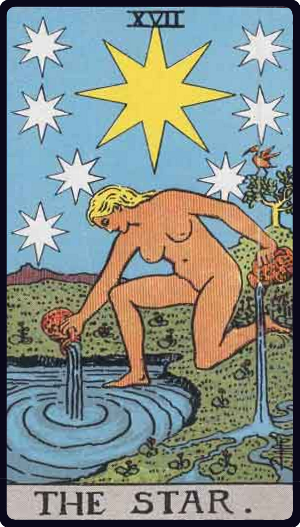
A worked example: suppose you ask the 3-card spread "Where is my job search heading?" and draw the Hermit (Past), the Chariot (Present) and the Star (Future). Read as a story, the Hermit suggests a period of stepping back and reflecting on what you really want; the Chariot suggests you are now pushing forward with focus; the Star is traditionally read as hope and renewal. The practical takeaway is not "you will be hired on Friday" but "the reflection paid off; keep your momentum and stay open". Our beginner's guide walks through more examples like this.
The card images and meanings used on Mooteeter follow the Rider-Waite-Smith tradition. The deck was designed in 1909: the occultist Arthur Edward Waite commissioned the artist Pamela Colman Smith to paint all 78 cards, and it was published by William Rider & Son in London. It was one of the first decks to give every Minor Arcana card, not only the Major Arcana, a full illustrated scene. That is why a beginner can often guess a card's mood just by looking at it, and why so many modern decks borrow its imagery. If you are new, start with Major vs Minor Arcana to see how the 22 and 56 cards divide the work.
Siamsee is the Thai name, taken from the Teochew Chinese dialect, for the fortune-stick practice known in Cantonese as kau chim. It developed in Chinese temples, and it arrived in Thailand with Chinese communities; today many Thai temples keep a cup of numbered sticks near the altar. You kneel, think of your question, and gently shake the cup until one stick falls out, then read the slip that matches its number. Our online version keeps that ritual feel with a set of 32 sticks. The Siamsee guide covers how people traditionally use it.
The daily fortune and compatibility tools draw on two ideas from Chinese metaphysics. Wu Xing, often translated as the Five Elements or Five Phases, describes Wood, Fire, Earth, Metal and Water as forces that feed each other (Wood feeds Fire, Fire makes Earth, Earth bears Metal, Metal carries Water, Water nourishes Wood) and also restrain each other. Bazi, or "Four Pillars", describes a person's birth moment as four pillars (year, month, day and hour), each made of two characters, eight in total. Our free tools use a simplified version based on your birth date; a full Bazi chart needs a birth time and a trained reader. More detail is in the Daily Fortune guide.
We built Mooteeter for reflection and entertainment. A reading can give you a new angle on a problem, put words to a feeling you have been avoiding, or remind you of options you had forgotten. It cannot guarantee an outcome, diagnose an illness, or tell you what another person is secretly thinking. Three misunderstandings come up often: