The Moon Tarot Card Meaning — Illusion and Intuition
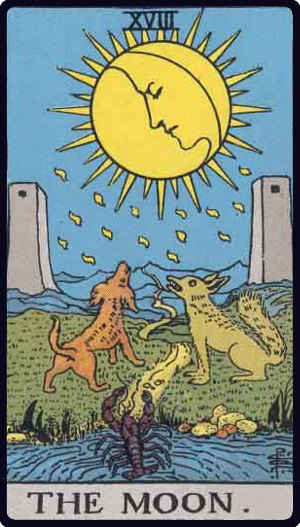
The Moon (card 18) — symbolizes uncertainty, imagination, fear and things not being what they seem. It advises patience until things are clearer.
1. About The Moon
The Moon is card 18 of the Major Arcana. In the Rider-Waite-Smith deck a large moon, shown with a face in profile, hangs between two towers. Drops shaped like the Hebrew letter yod fall from it. Below, a dog and a wolf howl upward, and a crayfish crawls out of a pool onto a path that winds between them toward distant hills.
The card is usually read as uncertainty, imagination, fear and things that are not what they seem. It is a night scene, lit only by reflected light. Readers often say the Moon describes a situation where you cannot see clearly yet, and where it is easy to mistake shadows for threats.
2. Where The Moon Comes From
- Diana in Milan. In the Visconti-Sforza cards the Moon shows the Roman goddess Diana, associated with hunting and chastity.
- Astronomers in other early decks. Mid-fifteenth-century Italian cards, such as the d'Este and "Charles VI" cards, show astrologers or astronomers with measuring instruments looking up at the moon. A Bolognese version of around 1500 shows astronomers bent over desks, a design that stayed largely unchanged for centuries.
- The Marseille landscape. In the Tarot de Marseille of the seventeenth and eighteenth centuries the now-familiar design appears: two towers, dogs (or a dog and a wolf), and a crayfish emerging from water. Earlier versions show the moon facing forward; later ones show it in profile.
- The 1909 card. The Rider-Waite-Smith card keeps the profile moon, gives it sixteen chief and sixteen secondary rays, and replaces earlier drops with yods.
- Astrology. The card corresponds to Pisces, the mutable water sign.
3. Reading the Symbols on the Card
| Symbol | Common reading |
|---|---|
| Moon with reflected light | Things seen partially; imagination filling the gaps. |
| Dog and wolf | The tame and the wild sides of our nature. Waite described them as the fears of the natural mind before the unknown. |
| Crayfish emerging from water | Something rising from the depths of the mind: a fear, a memory or an instinct. |
| Two towers | A threshold between the known and the unknown. |
| Winding path | A way forward exists, even if it is hard to see. |
Waite himself summarised the card as "the life of the imagination apart from the life of the spirit".
4. Upright Meaning by Area of Life
🌫 Uncertainty
Incomplete information.
😨 Anxiety
Fears that may be larger than the facts.
🌙 Imagination
Dreams, creativity and intuition.
🎭 Illusion
Things not being what they appear.
| Area | Upright | Reversed |
|---|---|---|
| Love | Mixed signals; uncertainty about where you stand; projecting fears onto a partner. | Confusion starting to clear; a misunderstanding coming to light. |
| Work | Unclear expectations; rumours; a decision made without enough information. | Getting clearer facts; anxiety easing. |
| Money | Be careful with offers you do not fully understand. | Spotting a problem before it grows. |
| Personal | Restless sleep, vivid dreams, worry. | Calming down; feelings becoming easier to name. |
5. Reversed Moon
Waite gave the reversed Moon as "instability, inconstancy, silence, lesser degrees of deception and error". Modern readers usually see it as the fog beginning to lift: confusion easing, fears becoming easier to examine, or a hidden matter surfacing. It can also mean that worry has turned inward and become quieter without being resolved.
6. Worked Examples
Example 1: Mixed signals
Someone unsure whether a new acquaintance is interested in them draws the Moon. A reader would typically say the situation is unclear, and suggest asking directly instead of guessing.
Example 2: A job offer with vague terms
A person considering a role whose contract details have not been confirmed draws the Moon in the present position. The usual advice is to get the details in writing before deciding. This is practical caution, not a prediction that something is wrong.
Example 3: Moon followed by the Sun
With the Sun in the future position, readers often describe a movement from confusion to clarity. The two cards are adjacent in the sequence.
7. The Moon in Different Spread Positions
In the past, the Moon points to a confusing period that still colours the present. In the present, it advises caution with decisions. In the future, it suggests a period where information may be incomplete. In the "hopes and fears" position of a Celtic Cross it often reveals an anxiety that is larger than the facts.
8. Common Card Pairings
- Moon + High Priestess: intuition and hidden knowledge; the two share lunar imagery.
- Moon + Star: hope and uncertainty side by side.
- Moon + Sun: confusion giving way to clarity.
- Moon + Devil: fears that keep a person stuck.
9. Common Misunderstandings
- "The Moon means someone is lying to you." Deception is one traditional meaning, but the card more often describes your own uncertainty. Do not accuse anyone on the strength of a card.
- "It is a bad-luck card." It describes a state of unclear vision, which passes.
- "It means you should trust your gut no matter what." The Moon also warns that fears can distort intuition. Checking facts is part of its advice.
- "It always relates to dreams." Dreams are one association, not the main one.
10. Frequently Asked Questions
❓ What zodiac sign goes with the Moon card?
Pisces, the mutable water sign.
❓ What did Waite write about the Moon?
Upright: "hidden enemies, danger, calumny, darkness, terror, deception, occult forces, error". Reversed: "instability, inconstancy, silence, lesser degrees of deception and error".
❓ Why are there a dog and a wolf?
They are usually read as the tame and wild sides of human nature reacting to the unknown.
❓ What does the Moon mean in a love reading?
Usually uncertainty or mixed signals. It suggests clear communication rather than assumptions. See Tarot for Love.
11. Final Thoughts
The Moon is the card of the half-seen: imagination, worry and intuition all at once. For more about reading cards in context, see the beginner guide or the three-card spread. Readings are intended for reflection and entertainment and cannot predict events.
Sources consulted: Wikipedia, The Moon (tarot card); Tarot Heritage, "La Luna/La Lune/The Moon"; A. E. Waite, The Pictorial Key to the Tarot (1910).