The Devil Tarot Card Meaning — Bondage and Liberation
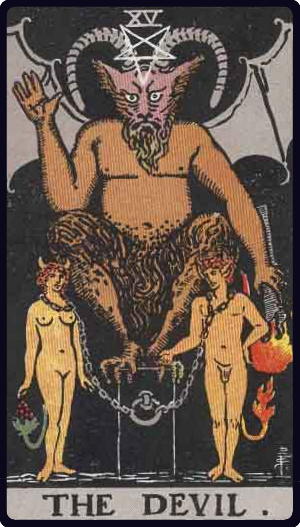
The Devil (card 15) — does not mean evil. It symbolizes attachment, desire, materialism and patterns that feel hard to break. In the traditional image the chains are loose, which readers take as a prompt to examine the hold.
1. About The Devil
The Devil is card 15 of the Major Arcana. In the Rider-Waite-Smith deck a horned figure with bat wings and animal-like feet crouches on a square pedestal. On his forehead is an inverted pentagram. His right hand is raised and his left hand holds a torch pointing downward. In front of the pedestal stand a naked man and woman, each with a chain around the neck. They have small horns and tails.
Most readers do not treat the card as a literal reference to evil. It is usually read as a picture of attachment: habits, desires, fears or situations that hold a person in place. Many readers also point out that the chains hang loosely, which suggests that the hold may be partly self-created.
2. Where The Devil Comes From
- Not in every early deck. The card does not appear among the surviving cards of the original Visconti-Sforza decks, so the earliest tarot imagery of it comes from other fifteenth-century Italian sets.
- The Marseille devil. In the Tarot de Marseille the figure is a hybrid creature, with a face on the belly, eyes on the knees, lion feet, bat wings and antlers, standing over smaller figures. It reads as grotesque rather than seductive.
- Lévi's Baphomet. In his Dogme et Rituel de la Haute Magie, published in the mid-1850s, the French occultist Éliphas Lévi illustrated a figure he called Baphomet. Later tarot artists drew on that image, and the 1909 Rider-Waite-Smith card is widely seen as part of that lineage.
- Astrology. The card is linked with Capricorn, an earth sign, and its ruling planet Saturn, which fits the themes of limits and constraint.
- Waite's wording. In The Pictorial Key to the Tarot (1910), the upright keywords are "ravage, violence, vehemence, extraordinary efforts, force, fatality", and the reversed ones "evil fatality, weakness, pettiness, blindness". That is considerably harsher than the "addiction and attachment" reading most people use today, which is a later development.
3. Reading the Symbols on the Card
| Symbol | Common reading |
|---|---|
| Horned figure with bat wings | The "shadow" side of drives and appetites; something that feeds on being unexamined. |
| Inverted pentagram on the forehead | Matter placed above spirit; priorities turned upside down. |
| Raised right hand | Often compared with a gesture of blessing, reversed here to a gesture of control. This is a reader's interpretation. |
| Torch held pointing downward | Energy or desire that burns downward; a flame that can warm or burn what it touches. |
| Naked man and woman, chained | Two people bound by their own attachments. The loose chains are the detail most readers emphasise. |
| Square pedestal | A fixed, material base; the situation feels solid even though it is a choice. |
4. Upright Meaning by Area of Life
⛓ Attachment
Habits, people or patterns that are hard to step away from.
🔥 Desire
Strong appetites, whether healthy or not.
🪞 Shadow
Parts of ourselves we avoid looking at.
💰 Materialism
Over-focus on money, status or possessions.
| Area | Upright | Reversed |
|---|---|---|
| Love | A strong, perhaps compulsive attraction; a relationship built on dependency or control. | Loosening a hold; recognising an unhealthy pattern and stepping back. |
| Work | Feeling stuck in a role for security or money; workaholism; being driven by status. | Reconsidering a role that no longer fits; breaking out of a rigid routine. |
| Money | Spending driven by impulse; being bound to debt or to a lifestyle. | Taking back control; cutting a habitual expense. |
| Personal | A habit or belief that feels impossible to change. | Becoming aware of the habit; the first step in changing it. |
5. Reversed Devil
Waite listed "evil fatality, weakness, pettiness, blindness" for the reversed card. Modern readers more often describe it as the loosening of a hold, such as noticing a pattern, questioning a dependency, or starting to step away from it. It can also describe a situation where the person has recognised the problem but has not yet acted. A balanced reading asks what the person gets out of the current arrangement, as well as what it costs them.
If the card concerns something that feels like a real addiction or a harmful relationship, a card is not a substitute for support. Speaking with a qualified professional or a trusted person is the sensible next step, and tarot can only offer a prompt for reflection.
6. Worked Examples
Example 1: A job kept for the paycheck
Someone who dislikes their job but keeps staying because of the salary draws The Devil in the present position. A reader would typically ask which part of the situation is a real constraint and which part is habit or fear, and leave the decision to the person.
Example 2: A relationship that feels hard to leave
A person caught in an on-again, off-again relationship draws The Devil next to The Lovers. The two cards are often compared because the Devil's image resembles the Lovers in reverse: two figures beneath a looming one. The reader's question would be what each person is choosing, and what feels like no choice at all.
Example 3: Reversed, as an advice card
A person who has been spending heavily draws The Devil reversed as advice. This is commonly read as an invitation to look at the habit and consider small, concrete steps to reduce it, not as a verdict about their character.
7. The Devil in Different Spread Positions
In the past position, The Devil points to a dependency or pattern that has shaped the present. In the present, it asks what is currently holding you in place. In the future position, readers treat it as a warning about a possible trap rather than as a prediction. As an obstacle card in a Celtic Cross it suggests that an attachment or fear is blocking progress. You can try this in the three-card spread or the Celtic Cross tool.
8. Common Card Pairings
- The Devil + Temperance: excess against moderation; Temperance comes just before The Devil in the sequence.
- The Devil + The Tower: the next card in the sequence; a structure built on attachment being shaken.
- The Devil + Strength: two cards about the animal side of human nature, one governed and one binding.
- The Devil + The Hermit: stepping away from compulsion into solitude and reflection.
9. Common Misunderstandings
- "The Devil means someone is evil." The card is not about moral judgement of another person. Readers use it to describe patterns and attachments.
- "The Devil means you are cursed or possessed." Tarot has no such meaning for the card; the idea comes from film and fiction, not from the deck's tradition.
- "The chains cannot be removed." In the image the chains are loose. This is the detail readers use to suggest the hold may not be absolute.
- "It always means addiction." Addiction is a common modern reading, but Waite's own keywords were about force, violence and fatality. The card can equally mean strong desire, ambition, or a sense of obligation.
10. Frequently Asked Questions
❓ Is The Devil a bad card?
Not necessarily. Many readers consider it useful because it names something that is usually left unspoken. It is better understood as a prompt to examine attachments than as a negative omen.
❓ What did Waite write about The Devil?
Upright: "ravage, violence, vehemence, extraordinary efforts, force, fatality". Reversed: "evil fatality, weakness, pettiness, blindness".
❓ What does The Devil mean in a love reading?
Usually a strong attraction or a dependent pattern, sometimes jealousy or control. It does not mean a relationship is doomed. See Tarot for Love for more on relationship readings.
❓ What does The Devil mean for work or career?
Often being tied to a role by money, status or fear, or being driven by ambition. The career tarot guide covers how readers approach work questions.
❓ Why does the card sometimes look different between decks?
Marseille-style decks show a grotesque hybrid creature, while Rider-Waite-Smith-style decks follow the Baphomet-influenced image. Artists adapt the symbolism, so always read the card in front of you.
11. Final Thoughts
The Devil is the card of attachment and the choices that sustain it, and its loose chains are part of the message. For more on why frightening cards are rarely literal, read Tarot Myths Debunked and the Death card guide. Readings are intended for reflection and entertainment, and are not a substitute for professional support.
Sources consulted: Wikipedia, The Devil (tarot card); A. E. Waite, The Pictorial Key to the Tarot (1910).