The High Priestess Tarot Card — Intuition and Inner Wisdom
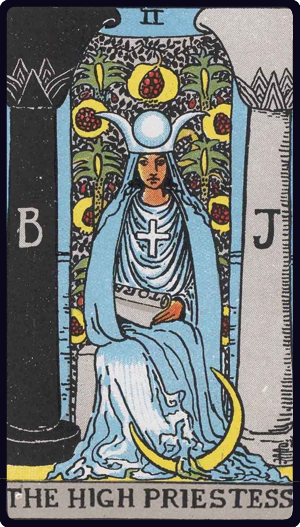
The High Priestess (card 2) — symbolizes intuition, hidden knowledge, mystery, and the subconscious mind. The answers you seek are within.
1. About The High Priestess
The High Priestess is card 2 of the Major Arcana. In the Rider-Waite-Smith deck she sits calmly between two pillars, one dark and one light, marked B and J. She holds a partly hidden scroll on her lap, a crescent moon rests at her feet, and behind her hangs a veil decorated with palm leaves and pomegranates. Where the Magician before her is all action and display, she is stillness and reserve.
Readers usually treat her as the card of what is not yet said: intuition, private knowledge, and information that has not come to the surface. She rarely tells you to act. More often she tells you that you do not have the full picture yet, and that waiting or listening is part of the answer.
2. Where The High Priestess Comes From
- She was originally "the Popess". In early Italian decks the card was La Papessa and in French decks La Papesse: a woman wearing a papal tiara. The Tarot de Marseille, the woodcut pattern that became standard in France, used this name.
- A real woman behind the Visconti card? The art historian Gertrude Moakley proposed that the Popess in the Visconti-Sforza deck depicts Sister Manfreda (Maifreda da Pirovano), a Visconti relative who was elected "pope" by the Guglielmite sect in Lombardy and was executed in 1300. Michael Dummett supported this view. It remains a theory, but it is the best-known one.
- Pope Joan and Protestant decks. The card has also been linked to the medieval legend of Pope Joan. A. E. Waite rejected that connection and preferred to associate the figure with older goddess traditions.
- The 1909 redesign. Waite and Pamela Colman Smith removed the papal imagery and gave her the pillars of Solomon's Temple (Jachin and Boaz), the TORA scroll and lunar symbols. In the Golden Dawn system the card is linked to the Moon.
This history helps explain why the card feels so different from the rest of the early sequence. It began as a provocative image (a woman in the Church's highest office) and was later recast as a figure of hidden spiritual knowledge.
3. Reading the Symbols on the Card
| Symbol | Common reading |
|---|---|
| Pillars marked B and J | Opposites held in balance: light and dark, known and unknown. She sits between them rather than choosing one. |
| The scroll marked TORA, partly covered | Law or knowledge that exists but is not fully shown. Some things are learned slowly, not read in one go. |
| Crescent moon at her feet | Cycles, intuition and the parts of life that change with time rather than through force. |
| Veil with pomegranates | A boundary between the visible and what lies behind it. You can sense there is more, but you cannot see it yet. |
| Her crown and blue robe | Dignity and calm. The crown is often compared to the headdress of the Egyptian goddess Hathor. |
4. Upright Meaning by Area of Life
🌙 Intuition
A quiet sense that something is true before you can prove it.
🤫 Discretion
Not every thought needs to be shared right away.
📜 Learning
Study, research and slow understanding rather than quick answers.
⏳ Patience
Waiting until more information is available before deciding.
| Area | Upright | Reversed |
|---|---|---|
| Love | Feelings that are real but not yet spoken; a connection that develops quietly. | Secrets or unspoken resentment; ignoring your own sense that something is off. |
| Work | Gather information before acting; a role involving research, advising or confidential matters. | Office gossip, missing information, or decisions made without consulting what you already know. |
| Money | Keep plans private and read the details before signing. | Hidden costs, or relying on rumours instead of facts. |
| Inner life | Time alone, journaling, reflection. | Feeling disconnected from your own judgement and seeking constant outside reassurance. |
5. The Reversed High Priestess
Waite's 1910 keywords for the reversed card were "passion, moral or physical ardour, conceit, surface knowledge". Modern readers tend to focus on the last phrase: surface knowledge. The reversed card often describes a situation where someone is reacting to the visible part of a problem while the important part stays hidden. It can also describe the reverse of her usual discretion: secrets leaking, or a person talking about something before they understand it. A practical question to ask is "What do I actually know here, and what am I assuming?"
6. Worked Examples
Example 1: A job offer that looks good on paper
Someone draws the High Priestess as advice while considering an offer that seems ideal. The reading is not "decline". It is "find out more": speak to people who work there, ask about the parts the interview skipped, and notice any hesitation you have not been able to explain.
Example 2: An unclear relationship
A person asks whether a friend has feelings for them, and the card appears upright in the "other person" position. Readers often take this as feelings that exist but are being kept private. It does not tell you what the friend will do, and it suggests that pressing for an answer may close the door rather than open it.
Example 3: Reversed, beside the Seven of Swords
In a question about a business partnership, the reversed High Priestess next to the Seven of Swords would usually prompt a reader to recommend checking records and agreements in writing, because the combination points to information not being shared openly.
7. Common Card Pairings
- High Priestess + Magician: knowing and doing. Gather what you need to know, then act on it.
- High Priestess + Moon: strong intuition but also uncertainty; dreams and impressions that need checking against facts.
- High Priestess + Hermit: a period of study or solitude chosen for a reason.
- High Priestess + Empress: the inner and outer sides of creativity; ideas forming quietly before they grow.
8. Common Misunderstandings
- "She means someone is lying to me." Hidden information is not the same as deception. Often the hidden thing is simply not known yet, including by you.
- "It is a card for women only." Older reading traditions sometimes used her to represent a female querent, but modern readers apply her qualities to anyone.
- "Intuition means I should trust every feeling." The card values inner knowledge alongside study (the scroll). It encourages listening to impressions, then testing them.
- "She is passive, so nothing will happen." She describes a period of preparation. Waiting deliberately is different from doing nothing.
9. Frequently Asked Questions
❓ What did Waite say the High Priestess means?
In The Pictorial Key to the Tarot (1910) he listed "secrets, mystery, the future as yet unrevealed", along with "silence, tenacity" and "wisdom, science". Many modern meanings grow out of that list.
❓ Is the High Priestess a yes or no card?
She is usually read as "not yet" or "you need more information", which makes her a poor fit for yes-or-no questions. That answer is itself useful when a decision is being rushed.
❓ What is the difference between the High Priestess and the Hierophant?
Both are religious figures, but the High Priestess represents private, inward knowledge, while the Hierophant represents teaching passed on through institutions and tradition.
❓ Why are the pillars labelled B and J?
They refer to Boaz and Jachin, the two pillars described at the entrance to Solomon's Temple. On the card they frame her as a guardian of a threshold.
❓ How can I work with this card in a daily draw?
Use it as a prompt to notice one thing you have been sensing but not saying, and write it down. Revisit the note after a week to see whether it was intuition or worry.
10. Final Thoughts
The High Priestess is the card of the pause before understanding. She asks you to respect what you do not know yet. To see how she sits beside the other early cards, read our Major vs Minor Arcana guide or the beginner guide. To explore a question in context, try the three-card spread or, for relationship questions, Tarot for Love. Card readings are meant for reflection and entertainment and do not predict events.
Sources consulted: Wikipedia, The High Priestess; A. E. Waite, The Pictorial Key to the Tarot (1910).