Death Tarot Card Meaning — It Doesn't Mean You Die!
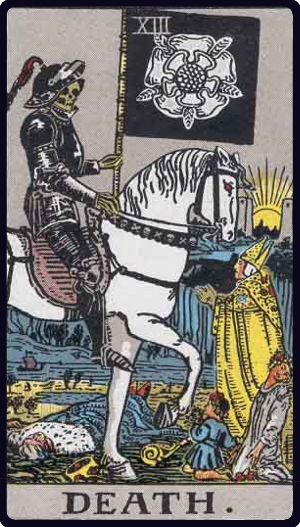
The Death card (13) — does NOT mean physical death. It symbolizes transformation, endings, and rebirth. Something must end so something new can begin.
1. About Death
Death is card 13 of the Major Arcana, and it is probably the card people fear most. In the Rider-Waite-Smith deck a skeleton in black armour rides a white horse, carrying a black banner decorated with a white rose. Before him a king has fallen, a bishop stands with hands pressed together, and a young woman and a child kneel or turn away. In the distance, a sun rises between two towers.
Despite the imagery, tarot readers almost never read this card as physical death. It is understood as an ending that makes room for something new: a job, a relationship, a habit, a stage of life. The rising sun in the background is the clue.
2. Where Death Comes From
- The medieval skeleton. Early 15th- and 16th-century decks show Death as a skeleton with a scythe or sickle, an image that echoes the late medieval Dance of Death, in which death comes to people of every rank.
- The card with no name. In the Tarot de Marseille and several other early decks the card was often left unlabelled. French tarot writers later called it the "arcane without a name". It still carries the number 13.
- The 1909 rider. Waite and Pamela Colman Smith replaced the reaping skeleton with an armoured rider, and included figures from different social ranks, a direct echo of the Dance of Death idea that death treats everyone equally. The banner's rose is often identified with the white rose of York.
- Astrology. In the Golden Dawn system the card corresponds to Scorpio.
3. Reading the Symbols on the Card
| Symbol | Common reading |
|---|---|
| Armoured skeleton on a white horse | Change that cannot be stopped or bargained with. |
| King, bishop, maiden and child | No status or innocence exempts anyone from endings. |
| Black banner with white rose | Renewal and purity within loss. |
| Rising sun between two towers | A new day after the ending; continuity beyond the change. |
| River and boat in the background | Passage from one state to another. |
4. Upright Meaning by Area of Life
🍂 Endings
Something has run its course.
🌱 Renewal
Clearing space for what comes next.
🚪 Transition
Moving from one life stage to another.
✂ Release
Letting go of what no longer fits.
| Area | Upright | Reversed |
|---|---|---|
| Love | The end of a relationship phase, or of a relationship itself; transformation of how two people relate. | Holding on to something that has already ended. |
| Work | A role or project ending; career change. | Fear of change keeping you in a role you have outgrown. |
| Money | Closing an old account or chapter; restructuring. | Avoiding necessary financial changes. |
| Personal | Shedding an old identity or habit. | Stagnation; resisting growth. |
5. Reversed Death
Waite's reversed meaning was "inertia, sleep, lethargy, petrifaction, somnambulism; hope destroyed". Modern readers usually see the reversed card as an ending that is being resisted: staying in a situation after it has finished, or delaying a change that is inevitable. The discomfort comes not from the change itself but from the effort of holding it back. The card asks what you are keeping alive out of habit.
6. Worked Examples
Example 1: A career that no longer fits
Someone ten years into a profession they have stopped enjoying draws Death upright. A reader would focus on endings and new beginnings in work, while the practical plan (savings, retraining, timing) is for the person to make.
Example 2: After a breakup
A person still hoping an ex will come back draws Death in the present position. The card is usually read as acknowledging that the relationship, in its old form, has ended, which can be the first step toward moving on.
Example 3: Reversed, with the Four of Pentacles
Death reversed beside the Four of Pentacles would typically point to clinging tightly to security or routine, even when it is preventing growth.
7. Death in Different Spread Positions
Where the card lands changes how readers apply it. In the past position of a three-card spread, it usually describes an ending that has already shaped the present, such as a move or a finished relationship. In the present, it points to a transition happening now that may feel unsettled. In the future or outcome position, readers take it as a stage that is likely to close so that something else can begin, not as a prediction of harm. In a Celtic Cross, Death in the "hopes and fears" position often reveals that the person both wants and fears the same change.
8. Common Card Pairings
- Death + Fool: an ending followed immediately by a new beginning.
- Death + Tower: sudden, dramatic change.
- Death + Hanged Man: a pause, then letting go.
- Death + Temperance: transformation followed by gradual healing and balance; these two cards are neighbours in the sequence.
9. Common Misunderstandings
- "Death means someone will die." Readers overwhelmingly interpret it as symbolic change. Tarot cannot predict anyone's death, and any reader who claims so should not be trusted.
- "It is the worst card in the deck." Many readers consider it one of the most helpful, because it clarifies what is ending.
- "Thirteen is unlucky, so the card is cursed." The number simply reflects its position in the sequence.
- "It always means a sudden change." Endings can be gradual. Sudden upheaval is more typical of the Tower.
10. Frequently Asked Questions
❓ Why is the Death card sometimes unnamed?
In the Tarot de Marseille and some early decks it was printed without a title. Later French writers referred to it as the arcane without a name.
❓ What did Waite write about Death?
Upright: "end, mortality, destruction, corruption". Reversed: "inertia, sleep, lethargy, petrifaction, somnambulism; hope destroyed". Modern readings are much more focused on transformation.
❓ Should I be scared if I draw Death?
No. It is a card about change. If you are worried about health or safety, speak to a qualified professional; a card cannot answer those questions.
❓ What does Death mean in a love reading?
Usually the end of a pattern or stage, not necessarily the end of the relationship. See Tarot for Love for more context.
11. Final Thoughts
Death is the card of necessary endings, and the sunrise on the horizon is part of its message. For more on why frightening cards are rarely literal, read Tarot Myths Debunked and the beginner guide; to explore a transition, use the three-card spread. These readings are intended for reflection and entertainment and cannot predict life events.
Sources consulted: Wikipedia, Death (tarot card); A. E. Waite, The Pictorial Key to the Tarot (1910).