The Tower Tarot Card Meaning — Sudden Change and Truth
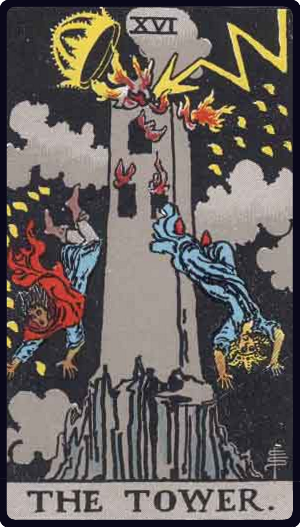
The Tower (card 16) — symbolizes sudden change, revelation and the collapse of unstable structures. Readers treat it as symbolic, not as a prediction of disaster.
1. About The Tower
The Tower is card 16 of the Major Arcana. In the Rider-Waite-Smith deck a tall grey tower stands on a rocky peak. Lightning strikes its top, knocking off a crown, flames pour from the windows, and two people fall headfirst through the air. Small tongues of fire, drawn in the shape of the Hebrew letter yod, fill the dark sky around them.
Of all the cards, this is the one most associated with sudden, disruptive change. Where Death often describes an ending that unfolds over time, the Tower is usually read as abrupt: a revelation, a shock or the collapse of something that looked solid. Many readers also see in it a release, since what falls was often built on a weak foundation.
2. Where The Tower Comes From
- Missing from the luxury decks. The card has been part of tarot since the fifteenth century, but some early hand-painted decks, including the Visconti-Sforza cards, do not include it. Early printed decks that survive complete do.
- Different names, different pictures. Belgian-style tarots and the seventeenth-century deck of Jacques Viéville called it La Foudre (the lightning) and showed a tree struck by lightning. The Minchiate deck showed people fleeing a burning building.
- The Marseille version. In the Tarot de Marseille a burning tower is struck by lightning or fire from the sky, its top dislodged, while two men fall against a field of multicoloured balls. The French title La Maison Dieu belongs to this tradition.
- The 1909 redesign. Pamela Colman Smith replaced the coloured balls with yod-shaped flames and placed a crown on the tower, which is commonly read as materialistic or proud thinking being cast down.
- Astrology and letters. The card corresponds to Mars. In the Golden Dawn system it carries the Hebrew letter Peh; the French occult system assigns Ayin.
3. Reading the Symbols on the Card
| Symbol | Common reading |
|---|---|
| Lightning bolt | A sudden insight or event that cannot be ignored. |
| Crown knocked from the top | Pride, certainty or status being toppled. |
| Tower on a rocky peak | Something built high on an unstable base. |
| Two falling figures | People thrown out of a situation they thought was secure. |
| Yod-shaped flames | Often read as a spiritual element within the upheaval; this is an interpretation of the design. |
4. Upright Meaning by Area of Life
⚡ Upheaval
A sudden change of circumstance.
💡 Revelation
A truth coming to light.
🏚 Collapse
A structure that could not hold.
🔓 Release
Freedom from something that was confining.
| Area | Upright | Reversed |
|---|---|---|
| Love | A shock in a relationship, such as a revelation or an argument that changes things. | A crisis narrowly avoided, or a change being delayed. |
| Work | Sudden restructuring, a project collapsing, or a realisation that a plan cannot work. | Resisting a change that is already underway. |
| Money | An unexpected expense or a plan that falls through. | Seeing a warning sign early and adjusting. |
| Personal | A belief or self-image breaking down. | Inner change happening quietly rather than dramatically. |
5. Reversed Tower
Waite's reversed meaning was "the same in a lesser degree", adding "oppression, imprisonment, tyranny". Modern readers usually read the reversed Tower in two ways: as upheaval that is smaller or more internal, or as a change that is being resisted or postponed. A useful question is whether the delay is protecting something worthwhile or simply prolonging an unstable situation.
6. Worked Examples
Example 1: A plan that suddenly falls apart
Someone whose business partner withdraws at the last minute draws the Tower in the present position. A reader would usually treat the card as naming the shock and asking what can be rebuilt on firmer ground. It does not say what will happen to the business.
Example 2: A secret coming out
A person who has just learned something difficult about a friend draws the Tower. The card fits the experience of a sudden revelation. The reading would focus on what the person now knows and how they want to respond.
Example 3: Tower followed by the Star
In a three-card spread, the Tower in the present and the Star in the future is a common teaching pairing: disruption followed by calm and hope. The two are adjacent in the sequence.
7. The Tower in Different Spread Positions
In the past, the Tower describes an upheaval that still shapes the present. In the present, it describes a situation already in motion. In the future, readers treat it as a warning to examine weak foundations rather than as a prediction of disaster. As an advice card, it can suggest letting go of a structure instead of propping it up. Try the positions with the three-card spread.
8. Common Card Pairings
- Tower + The Devil: the preceding card; attachments being broken by force.
- Tower + The Star: the following card; recovery after a shock.
- Tower + Death: major change, both sudden and final.
- Tower + Wheel of Fortune: events outside one's control.
9. Common Misunderstandings
- "The Tower predicts an accident or disaster." Readers use it symbolically. Tarot cannot predict accidents, and fear-based readings of this kind are not part of responsible practice.
- "It is purely negative." Many readers see value in it, because what collapses was often already unstable.
- "The change will be permanent damage." The card describes disruption, not what comes after. The Star follows it in the sequence.
- "Reversed means you have escaped." Reversed is often read as delay or a smaller-scale version, not as avoidance.
10. Frequently Asked Questions
❓ Why is the Tower called La Maison Dieu?
It is the title used in the Tarot de Marseille tradition. Other early decks called it the lightning (La Foudre) or showed a burning building.
❓ What did Waite write about the Tower?
Upright: "misery, distress, indigence, adversity, calamity, disgrace, deception, ruin". Reversed: "the same in a lesser degree", with "oppression, imprisonment, tyranny".
❓ What does the Tower mean in a love reading?
Usually a sudden shift or revelation. It does not decide whether a relationship survives. See Tarot for Love.
❓ Which planet goes with the Tower?
Mars.
❓ Should I be afraid of drawing the Tower?
No. It is a prompt to look at what is unstable. For worries about safety, money or health, a qualified professional is the right person to ask.
11. Final Thoughts
The Tower is the card of sudden change and of truths that cannot be ignored. To see why frightening cards are rarely literal, read Tarot Myths Debunked; for the bigger picture, see Major vs Minor Arcana. Readings are intended for reflection and entertainment and cannot predict events.
Sources consulted: Wikipedia, The Tower (tarot card); A. E. Waite, The Pictorial Key to the Tarot (1910).