The Lovers Tarot Card Meaning — Love, Choices, and Union
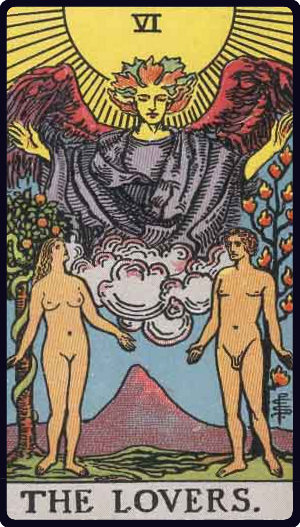
The Lovers (card 6) — symbolizes love, relationships, harmony, and important choices made from the heart. Not only romantic love, but all soul-level connections.
1. About The Lovers
The Lovers is card 6 of the Major Arcana. In the Rider-Waite-Smith deck a naked man and woman stand in a garden beneath a large winged figure, usually identified as the archangel Raphael, with a bright sun behind. Behind the woman is a tree with a serpent coiled around it; behind the man is a tree whose fruit look like flames. A mountain rises between them.
Most people assume the card simply means romance. Its history is more interesting than that, and many readers treat it just as much as a card about choice and values: what you commit to, and why.
2. Where The Lovers Comes From
- A wedding card. The earliest known version, in the Visconti di Modrone deck from around 1441, is widely linked to the marriage of Bianca Maria Visconti and Francesco Sforza. It shows an aristocratic couple with heraldic devices and a small white dog, a traditional emblem of fidelity.
- "Love" with Cupid. Later Italian woodblock decks titled the card L'Amore and showed courting couples with Cupid aiming his arrow.
- A young man between two women. In the Tarot de Marseille (17th century) the card became L'Amoureux, "the lover", singular: a young man stands between two women who seem to pull him in different directions, while Cupid aims from above. This is where the "choice" interpretation comes from.
- Adam and Eve. For the 1909 deck Waite reduced the figures to two and set them in Eden, with the Tree of Life behind the man and the Tree of Knowledge, with its serpent, behind the woman. In the Golden Dawn system the card is linked to Gemini.
So the same card has meant a dynastic marriage, romantic attraction, a difficult choice, and innocence before temptation. When you see it in a reading, all four layers are available.
3. Reading the Symbols on the Card
| Symbol | Common reading |
|---|---|
| The angel above | A higher perspective or shared ideal that the relationship answers to. |
| Tree with flames (behind the man) | Passion and desire. |
| Tree with serpent (behind the woman) | Knowledge, temptation and the consequences of choice. |
| The mountain between them | A shared goal, or a challenge the two must face together. |
| Nakedness | Honesty and vulnerability; nothing hidden between the two. |
4. Upright Meaning by Area of Life
💞 Connection
Deep attraction and mutual understanding.
⚖ Choice
A significant decision that reflects your values.
🤝 Partnership
Alignment between two people or two parts of yourself.
🔍 Honesty
Being open about what you want.
| Area | Upright | Reversed |
|---|---|---|
| Love | Strong mutual attraction; a relationship built on shared values; a decision to commit. | Mismatched values, temptation, or avoiding a decision about the relationship. |
| Work | A partnership or collaboration that fits; choosing work aligned with your values. | Conflicts of interest, or taking a job that clashes with what you believe. |
| Money | Decisions made jointly and openly. | Disagreements over money with a partner; impulsive purchases driven by desire. |
| Personal | Knowing what you stand for. | Inner conflict between what you want and what you think you should want. |
5. The Reversed Lovers
In 1910 Waite gave the reversed card as "failure, foolish designs", adding that another account speaks of "marriage frustrated and contrarieties of all kinds". Modern readings tend to describe misalignment: two people wanting different things, a choice being avoided, or a person acting against their own values. It does not automatically mean a breakup. Often it points to a conversation that needs to happen, or a decision that has been postponed for too long.
6. Worked Examples
Example 1: Two job offers
Someone torn between a well-paid offer and a lower-paid role they care about draws the Lovers as advice. In the Marseille sense of the card, the reading is about which choice reflects their values, and about being honest about what they would be giving up in either case.
Example 2: A long-distance relationship
A couple living in different countries draws the Lovers upright in the present position and the Two of Cups as the outcome. Readers would see strong mutual feeling, while the practical question of distance remains for the couple to solve.
Example 3: Reversed, with the Devil
If the Lovers appears reversed beside the Devil in a question about a relationship, readers often discuss unhealthy patterns, such as staying for comfort or habit rather than choice. The cards raise the issue; they do not decide it.
7. Common Card Pairings
- Lovers + Hierophant: formal commitment, or a clash between personal choice and tradition.
- Lovers + Devil: attraction mixed with attachment; asks whether the bond is freely chosen.
- Lovers + Empress: affection that is warm and physical.
- Lovers + Justice: a decision that needs fairness to both sides.
8. Common Misunderstandings
- "The Lovers means I will meet my soulmate." The card describes connection and choice, not a predicted meeting.
- "It is only about romance." Since the Marseille decks the card has also been read as a choice, and many readers use it for career and personal decisions.
- "Reversed means breakup." It more often points to disagreement or avoided decisions, which can be talked through.
- "The two people on the card are me and my partner." They may be, but they can also represent two sides of one person, such as head and heart.
9. Frequently Asked Questions
❓ Is the Lovers a yes card?
Many readers treat it as a "yes, if it matches your values", but it is better suited to questions about choice and alignment than to yes-or-no answers.
❓ Why is the card sometimes called L'Amoureux, singular?
In the Tarot de Marseille the title refers to the young man in the centre, who must choose between two women. The plural "Lovers" became standard in English.
❓ What does the Lovers mean for a single person?
It can point to a meaningful connection, but also to getting clear about what you want in a partner before looking. Our love tarot guide covers spreads for single readers.
❓ Who is the angel?
Waite identified the figure as an angel, and he is usually understood as Raphael. He watches over the pair rather than intervening.
❓ Can I use a compatibility tool alongside this card?
You can, as entertainment. Our compatibility tool uses a different system based on Chinese elements, so treat it as a separate perspective rather than confirmation.
10. Final Thoughts
The Lovers is about connection that is chosen, not just felt. For a relationship question, the seven-card love spread gives more context than a single draw, and the Hierophant and Chariot pages show the cards on either side of it in the sequence. Readings are offered as reflection and entertainment and cannot tell you what another person will do.
Sources consulted: Tarot Heritage, L'Amore / L'Amoureux / The Lovers; Wikipedia, The Lovers; A. E. Waite, The Pictorial Key to the Tarot (1910).