The Chariot Tarot Card Meaning — Victory Through Willpower
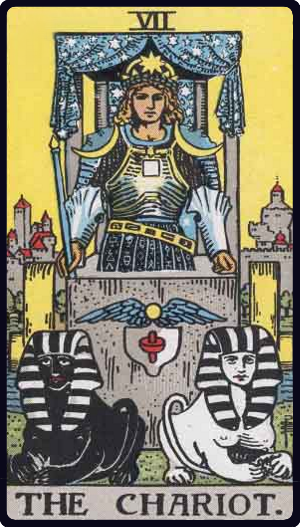
The Chariot (card 7) — symbolizes victory, willpower, determination, and triumph over obstacles. Steer your life with focus and discipline.
1. About The Chariot
The Chariot is card 7 of the Major Arcana. In the Rider-Waite-Smith deck a crowned figure in armour stands in a stone chariot under a canopy of stars, a walled city behind him. In front, two sphinxes, one black and one white, sit facing slightly different directions. He holds a wand but no reins.
That last detail is the key to how most people read the card today. Nothing physical holds the sphinxes together; the driver keeps them moving through will and focus. The Chariot is therefore a card about determination, direction and self-control in the middle of competing pressures.
2. Where The Chariot Comes From
- Triumphal processions. Early tarot trump cards were influenced by Petrarch's 14th-century poem I Trionfi (The Triumphs), in which allegorical figures ride in procession. Painters at the time illustrated these as parades of chariots, and the tarot Chariot belongs to that world.
- A woman in the chariot. In the Visconti decks of the 1440s and 1450s the rider is a woman. In one version the chariot is drawn by winged horses, which some historians associate with the allegory of Fame.
- The Marseille charioteer. The Tarot de Marseille shows a crowned man in a boxy canopied chariot with two horses seen from the front. He holds no reins, most likely because in a real parade a groom walked beside the horses.
- Sphinxes from French occultism. In the mid-19th century Éliphas Lévi described the chariot as drawn by black and white sphinxes, and Oswald Wirth drew a similar image in 1887. Waite and Pamela Colman Smith adopted the sphinxes for their 1909 deck. In the Golden Dawn system the card is linked to Cancer.
The missing reins began as a practical detail of parades and became, in the occult tradition, a symbol of mastery by will alone. It is a good example of how tarot meanings grow out of reinterpreting older images.
3. Reading the Symbols on the Card
| Symbol | Common reading |
|---|---|
| Black and white sphinxes | Opposing forces, such as emotion and logic or desire and duty, that must move in one direction. |
| No reins | Control through focus and intention rather than force. |
| Canopy of stars | Larger influences overhead; the driver is moving under conditions he did not choose. |
| Armour | Protection and readiness; the driver is prepared for resistance. |
| City behind him | Leaving the familiar and heading out with a purpose. |
4. Upright Meaning by Area of Life
🏁 Determination
Pushing through obstacles toward a clear goal.
🧭 Direction
Knowing where you are going and why.
🧘 Self-control
Managing conflicting feelings rather than being pulled by them.
🚀 Momentum
A period of progress after effort.
| Area | Upright | Reversed |
|---|---|---|
| Love | Working through differences together; a relationship moving forward with intention. | Power struggles, or one partner steering everything. |
| Work | Ambition, competition, a project that needs drive to finish. | Burnout, scattered effort, or forcing results that are not working. |
| Money | Disciplined effort toward a financial goal. | Impulsive decisions, or losing track of the plan. |
| Travel and moves | Readers often link the card to journeys and relocation. | Delays, or moving without a clear destination. |
5. The Reversed Chariot
Waite's reversed keywords in 1910 were "riot, quarrel, dispute, litigation, defeat". Modern readers usually describe the reversed Chariot as loss of direction: the two sphinxes pulling apart, energy going in several directions at once, or a person pushing hard without checking whether the destination still makes sense. It can also point to the opposite problem, a forceful personality who is trying to control what cannot be controlled. A practical step is to restate the goal in one sentence and drop whatever does not serve it.
6. Worked Examples
Example 1: Finishing a thesis
A student juggling a part-time job and a dissertation draws the Chariot upright. Readers would see focus and discipline as the way through: protecting time for the main goal and not letting smaller demands set the direction.
Example 2: A competitive job application
Someone applying for a promotion against colleagues draws the Chariot as the outcome. The card supports a confident, well-prepared approach. It does not predict that they will be chosen.
Example 3: Reversed, beside the Five of Wands
In a question about a team project, the Chariot reversed with the Five of Wands would usually be read as conflict over direction. The suggestion might be to agree on one shared goal before anyone pushes further.
7. Common Card Pairings
- Chariot + Strength: will and gentle control together; the two main cards about mastering yourself.
- Chariot + Emperor: ambition with structure; leadership on the move.
- Chariot + Lovers: acting on a choice already made.
- Chariot + Wheel of Fortune: momentum, with circumstances shifting quickly.
8. Common Misunderstandings
- "The Chariot means I will win." It describes drive and focus, not a guaranteed victory.
- "It is always about a car or a trip." Some readers link it to travel, but its core meaning is direction and control.
- "Control means suppressing my feelings." The sphinxes are not removed; they are guided. The card is about managing emotions, not ignoring them.
- "The missing reins are a mistake." In older decks they were simply not shown; in modern readings their absence is deliberate symbolism.
9. Frequently Asked Questions
❓ Why are there sphinxes instead of horses?
The sphinxes come from 19th-century French occultism, especially Éliphas Lévi. Earlier decks show horses.
❓ Is the Chariot a positive card?
Upright, most readers see it as encouraging: progress through effort. Waite's list also included "war" and "vengeance", though, so the card carries a reminder that ambition has costs.
❓ What does the Chariot mean in a love reading?
Upright it suggests moving forward together with a shared purpose; reversed it can show a tug-of-war. See Tarot for Love for more.
❓ How is the Chariot different from Strength?
The Chariot is outward drive and direction; Strength is inner patience and gentle persistence. Both are about self-mastery.
10. Final Thoughts
The Chariot shows progress that depends on keeping opposing forces moving in the same direction. For work questions see the career tarot guide, and to explore a goal of your own, try the Celtic Cross spread. Everything on this site is intended for reflection and entertainment rather than prediction.
Sources consulted: Tarot Heritage, Il Carro / Le Chariot / The Chariot; Wikipedia, The Chariot (tarot card); A. E. Waite, The Pictorial Key to the Tarot (1910).