Wheel of Fortune Tarot Card Meaning — Cycles and Fate
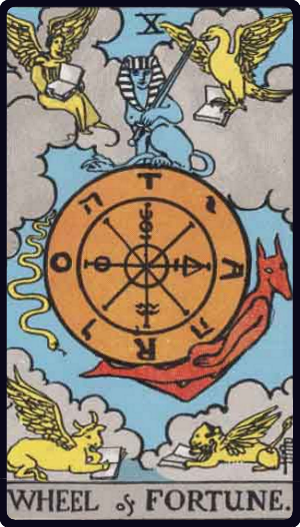
Wheel of Fortune (card 10) — symbolizes cycles, fate, destiny, and turning points. Life moves in cycles — what's down will rise; what's up will fall.
1. About The Wheel of Fortune
The Wheel of Fortune is card 10 of the Major Arcana. The Rider-Waite-Smith version is one of the most symbol-dense cards in the deck: a large orange wheel floats in the clouds, inscribed with the letters T-A-R-O and with Hebrew letters. A sphinx with a sword sits on top, a snake descends on the left, and a jackal-headed figure rises on the right. In the four corners, winged figures (an angel, an eagle, a lion and a bull) read from open books.
Readers use it to talk about change that is larger than any one person: cycles, turning points, timing and luck. It is the card that reminds you that circumstances move, and that both good and bad phases pass.
2. Where The Wheel Comes From
- The medieval Wheel of Fortune. The card is modelled on the Rota Fortunae, the wheel turned by the goddess Fortuna. The idea was popularised in the Middle Ages by Boethius's Consolation of Philosophy (6th century), which describes Fortune raising and lowering people regardless of merit.
- Four figures and four Latin words. In the Visconti-Sforza deck, figures cling to the wheel with labels in Latin: regnabo (I shall reign), regno (I reign), regnavi (I have reigned) and sum sine regno (I am without a kingdom). It is a compact picture of rise and fall.
- Animals on the wheel. In the Tarot de Marseille the human figures became strange animal-like creatures, with a crowned figure at the top.
- Occult reinterpretation. Éliphas Lévi in the 1850s redesigned the card with Egyptian-style figures, and Waite and Pamela Colman Smith built on that, adding the TARO/ROTA letters and the four winged creatures.
3. Reading the Symbols on the Card
| Symbol | Common reading |
|---|---|
| T-A-R-O letters | Can be read as TARO, ROTA (Latin for wheel) or TORA; a play on words that ties the wheel to the deck itself and to law. |
| Sphinx with sword on top | Wisdom and balance at the moment of change. |
| Snake descending | Typically identified with Typhon, the force that drags things downward. |
| Jackal-headed figure rising | Usually identified with Anubis, carrying things upward. |
| Four winged creatures with books | Often linked to the four Evangelists and to the four fixed zodiac signs: stability around the turning wheel. |
4. Upright Meaning by Area of Life
🔄 Change
Circumstances shifting, often outside your control.
⏱ Timing
A turning point; doors opening or closing.
🍀 Luck
Fortunate coincidences and unexpected opportunities.
♾ Cycles
Recognising patterns that repeat.
| Area | Upright | Reversed |
|---|---|---|
| Love | A new phase in a relationship, or meeting someone through chance. | Repeating the same relationship patterns; resisting a change that has already happened. |
| Work | Shifts in your company or industry; a well-timed opportunity. | Delays, or feeling stuck while things change around you. |
| Money | Variable fortunes; a reminder to plan for both up and down cycles. | A downswing; a cue to review spending and avoid risky bets. |
| Personal | Accepting that some things cannot be controlled. | Fighting change rather than adapting to it. |
5. The Reversed Wheel
Most modern readers describe the reversed Wheel as a downturn, resistance to change or repeating cycles. It is worth knowing that Waite himself gave a rather different reversed meaning: "increase, abundance, superfluity". So the idea that a reversed Wheel means "bad luck" is a later convention, not an old rule. A practical approach is to ask whether you are trying to hold the wheel still. Often the card reversed simply says that a change is uncomfortable, not that it is harmful.
6. Worked Examples
Example 1: A company restructure
Someone whose workplace is reorganising draws the Wheel upright. The reading would focus on the fact that the change is coming regardless, and that the useful questions are about how to position yourself rather than whether it will happen.
Example 2: Meeting someone by chance
A person asks about a new connection made through a coincidence. The Wheel in the present position fits the story: chance played a role. What happens next still depends on the people involved.
Example 3: Reversed, with the Five of Pentacles
In a money question, the reversed Wheel beside the Five of Pentacles would typically prompt a cautious reading: a difficult phase, and a reminder to protect basics and not chase losses.
7. Common Card Pairings
- Wheel + World: the end of one cycle and the start of the next.
- Wheel + Hermit: stepping back while circumstances turn.
- Wheel + Tower: a sudden, large change.
- Wheel + Justice: consequences of past actions coming round.
8. Common Misunderstandings
- "It means I will win money or the lottery." The card describes change and chance in general. It does not predict a win, and gambling decisions should never be based on a card.
- "Reversed means bad luck." Waite listed "increase, abundance" for the reversed card. The modern "downturn" reading is common, but not universal.
- "Fate is fixed, so nothing I do matters." Most readers use the card to encourage adaptability, not passivity.
- "The Wheel is about karma." Some modern readers link it to karma, but its historical source is Fortune, who was famously indifferent to merit.
9. Frequently Asked Questions
❓ What did Waite say the Wheel means?
"Destiny, fortune, success, elevation, luck, felicity" upright, and "increase, abundance, superfluity" reversed.
❓ What do the letters on the wheel spell?
Read clockwise from different starting points, they can spell TARO, ROTA or TORA.
❓ Is the Wheel of Fortune a good card?
It is neutral. It points to change; whether that is welcome depends on where you are on the wheel.
❓ How does the Wheel relate to the Death card?
Both are about change, but the Wheel is cyclical and often external, while Death describes a definite ending that clears the way for something new.
10. Final Thoughts
The Wheel of Fortune asks how you respond when things move. For a broader picture of a turning point, try the Celtic Cross, or for a daily perspective the daily fortune tool. Our tarot myths article explains why no card can predict a lottery result. All content here is for entertainment and reflection.
Sources consulted: Wikipedia, Wheel of Fortune (tarot card); Tarot Heritage; A. E. Waite, The Pictorial Key to the Tarot (1910).