The Emperor Tarot Card Meaning — Authority and Structure
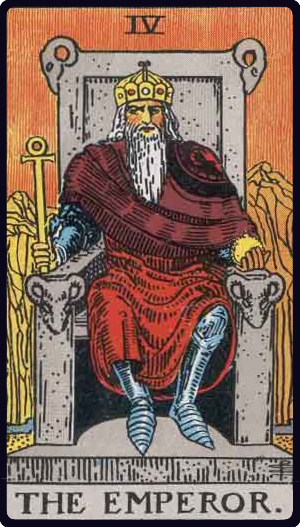
The Emperor (card 4) — symbolizes authority, leadership, structure, and stability. He brings order and protective masculine energy.
1. About The Emperor
The Emperor is card 4 of the Major Arcana. In the Rider-Waite-Smith deck he sits on a square stone throne carved with rams' heads, wearing armour under a red robe, holding a sceptre in one hand and an orb in the other. Behind him is a bare, rocky mountain range. Compared with the green garden of the Empress just before him, his world is hard, dry and built to last.
Readers use the card to talk about structure: rules, plans, responsibility, boundaries and the people or systems that hold authority. It can describe a boss, a parent, an institution, or the part of yourself that makes decisions and keeps commitments.
2. Where The Emperor Comes From
- A figure of the Holy Roman Empire. The Emperor appears in the earliest Italian tarot decks of the 15th century as an enthroned ruler. A version in the Visconti di Modrone deck is usually dated to the early 1440s. The Italian name is L'Imperatore, the French L'Empereur.
- The Marseille pose. In the Tarot de Marseille pattern (standardised in the 17th century) he is shown in profile, seated with legs crossed, a shield with an eagle at his side.
- Regional variants. Some decks altered the trio of Emperor, Empress and Pope for political or religious reasons. A Bolognese deck from 1725 replaced the papal and imperial cards with "Moors", for example, so as not to offend the authorities.
- The Golden Dawn layer. The Hermetic Order of the Golden Dawn linked the card to Aries, a fire sign associated with Mars, and Pamela Colman Smith's design reflects this with the rams on the throne.
3. Reading the Symbols on the Card
| Symbol | Common reading |
|---|---|
| Square stone throne | Stability, foundations, things built to endure. |
| Rams' heads | Aries: initiative, drive and leadership, sometimes stubbornness. |
| Armour under the robe | Readiness to defend what has been built; authority that is backed by responsibility. |
| Sceptre and orb | Rule over a territory, whether a country, a team or your own life. |
| Barren mountains | Discipline and endurance. Little grows here, which hints at the cost of rigid control. |
4. Upright Meaning by Area of Life
🏛 Structure
Rules, systems and routines that make goals achievable.
🛡 Protection
Taking responsibility for people who depend on you.
📋 Planning
Clear goals, timelines and decisions.
👑 Authority
Leadership, or dealing with someone who has power over a situation.
| Area | Upright | Reversed |
|---|---|---|
| Love | Commitment, reliability and clear agreements; a partner who shows care through practical support. | Control, jealousy, or one partner making every decision. |
| Work | A leadership role, formal processes, contracts, or the need to organise your work properly. | A rigid manager, unclear roles, or resisting all structure. |
| Money | Budgets, long-term planning and discipline. | Poor planning or rules that are ignored until problems appear. |
| Daily life | Routines that free up energy for what matters. | Routines so rigid they leave no room for change. |
5. The Reversed Emperor
Reversed, the Emperor is usually read as structure that has tipped too far one way or the other. On one side is excess control: micromanagement, inflexible rules or a person who confuses authority with dominance. On the other is missing structure: no plan, no boundaries, nobody taking responsibility. When it appears, a useful question is which of the two is closer to the situation, because the advice for each is the opposite. One needs loosening, the other needs firming up.
6. Worked Examples
Example 1: Starting a business
Someone with a creative business idea draws the Emperor in the "what you need" position. The reading would point to the dull but essential pieces: registration, contracts, a simple budget and a regular schedule. It is not a statement about whether the idea is good.
Example 2: A difficult manager
A person asks about tension at work and draws the Emperor reversed in the "other person" position. A reader would likely describe a manager who relies on control rather than trust, and might suggest putting agreements in writing and clarifying expectations, rather than trying to win a power struggle.
Example 3: Setting boundaries in a family
Someone draws the Emperor upright while asking how to handle relatives who drop by unannounced. Here the card works as advice to set and keep clear rules politely, which is the protective side of authority.
7. Common Card Pairings
- Emperor + Empress: structure and nurture together; a balanced household or team.
- Emperor + Justice: legal matters, contracts or formal decisions.
- Emperor + Hierophant: institutions and established systems; working within a large organisation.
- Emperor + Tower: a structure that has become too rigid and is being shaken.
8. Common Misunderstandings
- "The Emperor always represents a man in my life." He can, but more often he represents a role or an approach, which anyone can take.
- "It means a promotion is coming." The card describes leadership and responsibility. It does not predict specific career events.
- "Authority is always negative." The upright card is about protective, accountable authority. Problems arise in the reversed or extreme form.
- "He has nothing to do with feelings." Reliability and keeping promises are ways of caring, and many readers see that in this card.
9. Frequently Asked Questions
❓ What did Waite say about the Emperor?
His 1910 keywords for the upright card included "stability, power, protection, realization", and for the reversed card "benevolence, compassion, credit" along with "confusion to enemies" and "immaturity". Many modern readers simplify the reversed card to control or lack of structure.
❓ Why rams on the throne?
The Rider-Waite-Smith deck follows the Golden Dawn link between this card and Aries, the sign symbolised by the ram.
❓ How is the Emperor different from the Chariot?
The Emperor rules a settled domain; the Chariot is in motion, directing energy toward a goal. One maintains, the other advances.
❓ Can the Emperor be read in a love question?
Yes. Upright it describes commitment and dependability; reversed it can point to control. See Tarot for Love for spreads.
10. Final Thoughts
The Emperor reminds you that plans need a frame to stand in, and that the frame should serve people rather than the other way round. To read him alongside other cards, try the Celtic Cross or the three-card spread, and see the career tarot guide for work questions. Readings here are for reflection and entertainment, not professional advice.
Sources consulted: Wikipedia, The Emperor (tarot card); Tarot Heritage; A. E. Waite, The Pictorial Key to the Tarot (1910).