The Fool Tarot Card Meaning — A Fresh Start with Open Heart
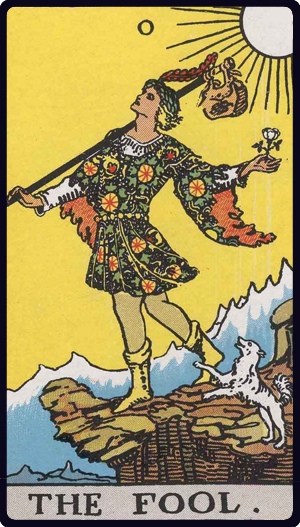
The Fool is card 0 of the Major Arcana — symbolizing new beginnings, innocence, and a fearless leap into the unknown. It's about trusting the universe and embracing fresh starts.
1. About The Fool
The Fool is card 0 of the Major Arcana, and in most modern decks it is the first card you meet. In the Rider-Waite-Smith image (illustrated by Pamela Colman Smith and published in 1909), a young man walks toward the edge of a cliff with his face tilted up, a small bundle of belongings on a stick over his shoulder, a white rose in his hand, and a small dog bounding at his feet. A bright sun sits behind him and snowy peaks fill the background. He is not looking where he is stepping, and that single detail is what the whole card is built around.
It is easy to read this as a warning ("he is about to fall"), and some readers do. A more common modern reading is that the image captures a moment before experience: the person has not yet learned what can go wrong, so they move with a lightness that more experienced people have lost. Both readings are held at once in the card, which is why the Fool is better described as "a beginning with no safety net" than as simply good or bad.
2. Where The Fool Comes From
The Fool is one of the oldest figures in tarot, and its history explains why it is the only Major Arcana card that is usually left without a number.
- The earliest painted decks (mid-15th century). In the Visconti-Sforza deck, made in Italy around 1450, the Fool is a ragged vagabond with torn clothing and no shoes, carrying a long stick. Historians of tarot (such as the writers at Tarot Heritage) note that this figure resembles Giotto's early 14th-century image of Folly. The point was not that he was funny; he was the person with no rank and no standing in a society organised around rank.
- A card outside the ranking. Tarot began as a card game, with the trump cards ranked against one another. The Fool had no place in that ranking, and in many regional games it acted as a special card that did not behave like the others. Some early decks, including the 15th-century Sola Busca, do mark it with a 0, while some 18th-century Belgian decks numbered it 22 and placed it last.
- Names. In Italian it is Il Matto ("the madman"); in the Tarot de Marseille it is Le Mat. Early images vary widely: a barefoot madman, a wandering beggar with a knapsack, or a jester with bells.
- The Rider-Waite-Smith version. The 1909 deck turned the figure into a youthful traveller and added the dog, the white rose and the cliff. In his 1910 book The Pictorial Key to the Tarot, A. E. Waite listed words like "folly, mania, extravagance" for the upright card, which is a far less cheerful list than most modern readers use today. The "joyful new beginning" interpretation that dominates now is largely a later reading of Smith's image.
This is worth knowing because it shows that tarot readers have always disagreed about the Fool. The card has been a beggar, a madman, a jester and a hopeful traveller, and the modern "leap of faith" meaning is one stage in a long history rather than the single true answer.
3. Reading the Symbols on the Card
| Symbol | What readers commonly take it to mean |
|---|---|
| The cliff edge | A threshold: the point where the familiar ends and the untested begins. It can signal either courage or carelessness depending on the cards around it. |
| The small dog | Often read as instinct or a loyal companion. Some readers see it as a warning voice trying to hold him back; others see it as encouragement. The image does not settle it. |
| The white rose | Commonly linked to purity of intention and desire held lightly in the hand. |
| The small bundle on a stick | He carries very little. Readers use this to talk about starting with what you have rather than waiting until you feel fully equipped. |
| The bright sun and open sky | Optimism and clarity. Nothing in the picture is hidden, which fits the card's association with openness. |
4. Upright Meaning by Area of Life
🌅 New Beginnings
A fresh start where the outcome is unknown, such as a move, a course, a project or a change of direction.
🎈 Openness
Approaching something without assuming you already know how it will go.
🎒 Spontaneity
Acting on an impulse that feels right rather than over-planning every step.
🌱 Potential
Many paths are still open because no choice has yet closed any of them.
| Area | Upright | Reversed |
|---|---|---|
| Love | Meeting someone without a script, or letting go of old expectations so a relationship can start fresh. | Rushing in on a feeling alone, ignoring red flags, or avoiding commitment by never quite arriving. |
| Work | A new role, an unconventional path, or starting as a beginner in a different field. | Quitting or committing without a plan, or staying stuck because starting over feels embarrassing. |
| Money | Willingness to try something new with money, ideally with a limit you can afford to lose. | Impulsive spending or risk taken because it feels exciting rather than because it was thought through. |
| Inner life | Curiosity, humility and a beginner's willingness to be wrong. | Fear of looking foolish, which keeps a person at the cliff's edge indefinitely. |
5. The Reversed Fool
When the Fool lands upside down, readers tend to look at two opposite problems. The first is recklessness: the step off the cliff is taken without checking the ground, and warnings are being brushed aside. The second, and in practice just as common, is paralysis: the person wants to begin but is waiting for a guarantee that will never come. Waite's own list for the reversed card ("negligence, absence, carelessness, apathy") leans toward the first reading. Which one fits depends on the question. If you asked "should I do this?" and are already rushing, it probably points at caution. If you have been postponing the same decision for months, it may point at the fear.
6. Worked Examples
Example 1: A career-change question
Someone in their thirties asks, "Should I leave accounting to study design?" and draws the Fool upright as the outcome card, with the Four of Pentacles (holding tightly to security) as the obstacle. A reasonable reading: the beginning itself is not the problem, but the obstacle card suggests the real tension is between the wish for security and the wish to start something new. The practical conversation is about how to test the change cheaply, for example a part-time course, rather than leaping all at once.
Example 2: A love question
Someone who has just ended a long relationship asks about dating again. The Fool appears in the "present" position. Here it is most naturally read as permission to be a beginner: there is no need to compare every new person to the last one. If the Fool had appeared reversed next to the Seven of Swords, a reader might instead raise the question of whether the person is hiding something, or ignoring something they already suspect.
Example 3: A money question
Someone asks about putting savings into a friend's new business. The Fool upright beside the Five of Pentacles would be read as a caution as much as an encouragement: the enthusiasm is real, but the card does not say the venture will succeed. A sensible reading is to set a limit on what could be lost and to ask what the friend has already tested.
7. Common Card Pairings
- Fool + Magician: a beginning, followed immediately by the tools and skill to act on it. Many readers treat the two as consecutive steps: the Fool is the decision to start, the Magician is the first deliberate move.
- Fool + Lovers: a choice made from the heart in a situation where the outcome is not yet clear.
- Fool + Death: something ends and a new unplanned chapter begins, often before the person feels ready.
- Fool + Tower: a sudden change forces a fresh start; the Fool suggests the question is how to meet it with openness rather than resistance.
8. Common Misunderstandings
- "The Fool means I am being foolish." In older decks "Fool" meant an outsider or a person outside the usual rules, not someone to be mocked. The card is about the position of a beginner, not about intelligence.
- "It is always a green light." The card describes openness and risk together. It does not say a leap will turn out well, and Waite's original wording for the upright card was far more cautionary than the modern one.
- "Zero means nothing." Zero is the starting point for everything that follows, which is why the card is placed at the beginning of the Major Arcana sequence. It is empty of experience, not of meaning.
- "The dog is just decoration." The dog is one of the most debated details on the card. Different readers see it as instinct, as a companion, or as a warning, and all three readings are used in practice.
9. Frequently Asked Questions
❓ Is The Fool a good or a bad card?
Neither by itself. It describes a state: starting without certainty. Whether that is encouraging or concerning depends on the question and on neighbouring cards. A Fool next to the Tower or the Seven of Swords reads very differently from a Fool next to the Sun or the Ace of Wands.
❓ Why does the card have no number, or the number 0?
In the early Italian card game the Fool stood outside the ranking of the other trumps. Some early decks left it blank, a few marked it 0 and some later decks placed it at the end as 22. The "zero at the start of the journey" idea was popularised by later esoteric writers.
❓ What does The Fool mean in a yes-or-no question?
Tarot is not designed to give clean yes-or-no answers, but if you use the card that way, the Fool is usually read as "yes, if you are willing to accept uncertainty", and it leaves the decision with you rather than predicting an outcome.
❓ How should I use The Fool when I am anxious about change?
Try this as a reflection exercise, not a prediction: write down what you already have (the bundle on the stick), what you would still need to learn, and what the smallest reversible first step would be. If a step can be undone, it is much closer to the Fool's openness than to recklessness.
❓ Where does The Fool sit in a spread?
In a three-card past-present-future spread, the Fool in the future position is usually read as an upcoming change you have not yet planned for. In the present position, it describes where you are standing now. In the Celtic Cross it is most often read in the "outcome" or "hopes and fears" positions as a question about whether you are open to the unfamiliar.
10. Final Thoughts
The Fool is a card about a threshold. It asks what you would do if you did not need to be certain first, and it leaves the answer to you. For more background on how cards like this fit together, see our tarot beginner guide and the explanation of the Major and Minor Arcana. If you want to try a spread yourself, you can draw a single card or use the three-card spread, and for questions about relationships or work see Tarot for Love and Tarot for Career. Tarot is a tool for reflection and entertainment; it cannot predict what will happen, and it is not a substitute for professional advice.
Sources consulted: Wikipedia, The Fool (tarot card); Tarot Heritage, From Il Matto to the Fool; A. E. Waite, The Pictorial Key to the Tarot (1910).