The Hanged Man Tarot Card Meaning — New Perspective
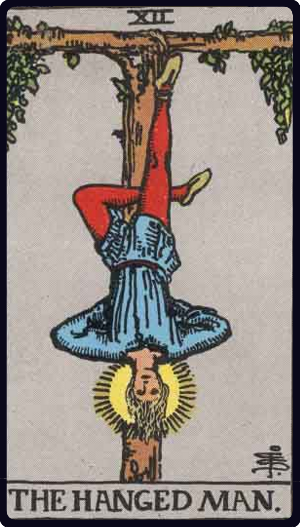
The Hanged Man (card 12) — symbolizes surrender, new perspective, and willing sacrifice. Sometimes you must stop fighting to see the truth.
1. About The Hanged Man
The Hanged Man is card 12 of the Major Arcana. In the Rider-Waite-Smith deck a man hangs upside down by one foot from a living wooden beam shaped like a T. His free leg is bent behind the other, his hands are behind his back, and a golden halo shines around his head. Strikingly, his face is calm. A. E. Waite wrote that the face "expresses deep entrancement, not suffering" and that the figure suggests "life in suspension, but life and not death".
Modern readers treat the card as one of pause, surrender and a change of perspective. It describes the moments when pushing harder does not work and the useful move is to stop, wait and see the situation differently.
2. Where The Hanged Man Comes From
- A traitor's punishment. In 15th-century Italy, being hung upside down by one foot was associated with pittura infamante, "defaming pictures" painted on public walls to shame traitors and debtors who had escaped. Early Italian decks sometimes called the card Il Traditore, the traitor.
- Bags of money. Some early versions show the man holding money bags, which many historians connect with Judas and betrayal.
- Le Pendu. In the Tarot de Marseille the card became Le Pendu, the hanged one, and the specific link with traitors faded.
- A spiritual reading. 19th- and early 20th-century occultists reinterpreted the image as voluntary sacrifice and initiation. Waite pointed out that the gallows forms a Tau cross and the legs form a fylfot cross, and he added the halo.
The journey from public humiliation to spiritual insight is one of the most dramatic in tarot. It is also why the card can feel so contradictory: it carries both discomfort and calm.
3. Reading the Symbols on the Card
| Symbol | Common reading |
|---|---|
| Hanging upside down | Seeing the world from a reversed point of view. |
| Calm face | Acceptance; the suspension is not torment. |
| Halo | Insight or realisation that comes from the pause. |
| Living T-shaped tree | Growth continuing even while the figure is still. |
| Crossed leg forming a "4" | Waite described a fylfot cross; many readers see stability inside an unusual position. |
4. Upright Meaning by Area of Life
⏸ Pause
Waiting rather than forcing an outcome.
🔁 New perspective
Looking at a problem from a completely different angle.
🤲 Letting go
Releasing control over what you cannot change.
🎁 Sacrifice
Giving something up now for a longer-term gain.
| Area | Upright | Reversed |
|---|---|---|
| Love | A relationship in limbo; time to reflect instead of pushing for answers. | Staying stuck out of fear; giving up too much for the other person. |
| Work | A project on hold; a delay that allows a rethink. | Stalling, or making sacrifices nobody asked for. |
| Money | Postponing a purchase or decision until you know more. | Indecision that costs more than acting would. |
| Personal | Surrender, meditation, accepting uncertainty. | Feeling like a victim of circumstances. |
5. The Reversed Hanged Man
Waite gave a short list for the reversed card: "selfishness, the crowd, body politic". Modern readers tend to describe it as a pause that has gone on too long or produced nothing: waiting without reflecting, or sacrificing without purpose. It can also mean resisting a necessary pause, insisting on action when the situation really needs patience. The question to ask is "Is this waiting giving me anything?"
6. Worked Examples
Example 1: A job search that has stalled
After months of applications, someone draws the Hanged Man upright. Readers would suggest stepping back to reconsider the approach: a different field, a different kind of role, or improving one skill before continuing.
Example 2: Waiting for someone to decide
A person waiting for a partner to commit draws the card in the present position. It describes the limbo honestly and invites the person to consider what they want, rather than only waiting for the other person.
Example 3: Reversed, with the Eight of Cups
If the Hanged Man appears reversed next to the Eight of Cups, readers often see a person who has been waiting too long for something to change and may be ready to walk away.
7. Common Card Pairings
- Hanged Man + Death: a pause before a definite ending; surrender followed by release.
- Hanged Man + High Priestess: waiting for understanding to surface.
- Hanged Man + Chariot: the conflict between pushing ahead and stopping to think.
- Hanged Man + Star: hope after a difficult waiting period.
8. Common Misunderstandings
- "The Hanged Man means death or punishment." Waite stressed that it shows "life and not death". The punishment origin is historical, not the modern meaning.
- "It means I am being betrayed." The early "traitor" name is a historical curiosity; modern readers rarely read it that way.
- "Sacrifice means I must give up what I love." It refers to a voluntary trade-off, often of time or control.
- "It is the same as Odin hanging on the tree." Some modern readers connect it with the Norse myth, but that link was made much later and is not part of the card's documented history.
9. Frequently Asked Questions
❓ What did Waite write about the Hanged Man?
Upright: "wisdom, circumspection, discernment, trials, sacrifice, intuition, divination, prophecy". Reversed: "selfishness, the crowd, body politic".
❓ Is the Hanged Man a bad card?
Not usually. It describes a pause and a change of perspective. Whether that is frustrating or helpful depends on the situation.
❓ How long does the "pause" last?
Tarot cannot give reliable timing. The card describes the nature of the period, not its length.
❓ What does the Hanged Man mean in a career reading?
Often a delay or a project on hold, and an invitation to rethink. See the career tarot guide.
10. Final Thoughts
The Hanged Man reminds you that stopping can be productive. For more context on how cards pair, try the three-card spread, and see the tarot myths article for why "scary" cards are rarely literal. Content here is offered for reflection and entertainment only.
Sources consulted: Wikipedia, The Hanged Man (tarot card); Tarot Heritage; A. E. Waite, The Pictorial Key to the Tarot (1910).