The Hermit Tarot Card Meaning — Solitude and Inner Wisdom
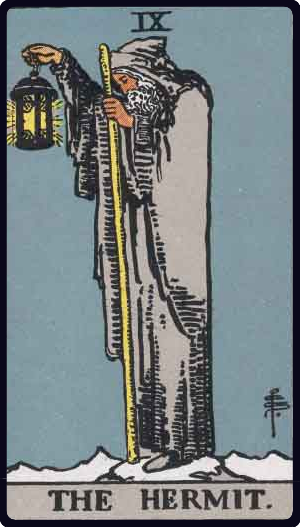
The Hermit (card 9) — symbolizes introspection, solitude, inner wisdom, and spiritual seeking. Step away from the world to find your truth.
1. About The Hermit
The Hermit is card 9 of the Major Arcana. In the Rider-Waite-Smith image an old man in a grey hooded cloak stands alone on a snowy peak at night. In his right hand he holds a lantern with a six-pointed star inside; in his left, a tall staff. He looks down, as if lighting the path for someone climbing behind him.
Readers use the Hermit for periods of withdrawal, reflection and study: stepping back from noise to work something out. It can describe a mentor or a teacher too, someone further along the path who carries a light for others.
2. Where The Hermit Comes From
- Originally Time, not a monk. In early Italian decks the figure was an old man with an hourglass, sometimes called Il Tempo (Time), Il Vecchio (the Old Man) or Il Gobbo (the Hunchback). He represented old age and the passing of time, a theme shared with Petrarch's poem The Triumphs.
- From hourglass to lantern. Toward the end of the 15th century, some decks began to show a lantern instead of an hourglass, and the figure gradually became a hermit or wandering monk. French decks of the 17th century named him L'Ermite, and the Tarot de Marseille fixed the image of a cloaked old man with a lamp.
- On the mountain. The Golden Dawn tradition placed him on a mountaintop, and Pamela Colman Smith's 1909 design follows that. The Golden Dawn linked the card to Virgo.
Knowing the hourglass origin adds depth to modern readings. The Hermit is not just alone; he is someone who has lived long enough to know that some things only become clear with time.
3. Reading the Symbols on the Card
| Symbol | Common reading |
|---|---|
| Lantern with a six-pointed star | A limited but real light: enough to see the next step, not the whole road. Eden Gray described it as the lamp of truth. |
| Staff | Support and experience; tools that help on a long path. |
| Grey cloak | Discretion and modesty; the Hermit does not advertise himself. |
| Snowy mountain peak | Height and solitude; the view that comes from distance. |
| Looking downward | Awareness of those still climbing; the role of guide. |
4. Upright Meaning by Area of Life
🕯 Reflection
Time to think things through away from other people's opinions.
📖 Study
Deep, focused learning.
🧭 Guidance
Seeking or becoming a mentor.
🏔 Solitude
Choosing quiet on purpose, not out of avoidance.
| Area | Upright | Reversed |
|---|---|---|
| Love | Needing space to understand what you want; a slow, thoughtful connection. | Isolation that pushes others away, or loneliness that is not chosen. |
| Work | Specialist work, research, or a pause to reconsider your direction. | Cut off from the team, or avoiding feedback. |
| Money | Cautious, considered decisions; living simply. | Over-caution that prevents necessary action. |
| Inner life | Meditation, journaling, retreats. | Withdrawing so far that you lose perspective. |
5. The Reversed Hermit
Waite's list for the reversed card was "concealment, disguise, policy, fear, unreasoned caution". Modern readers often describe the reversed Hermit as solitude that has gone wrong: isolation that feels like a wall rather than a retreat, or a reluctance to come back down the mountain and rejoin ordinary life. It can also describe the opposite problem, being unable to spend any time alone, always filling silence with distraction. The question is whether solitude is serving you right now.
6. Worked Examples
Example 1: After a burnout
Someone recovering from an exhausting year draws the Hermit as advice. Readers would see permission to slow down and spend time on reflection before making big decisions about what comes next.
Example 2: Looking for a mentor
A junior engineer asks how to grow faster and draws the Hermit in the "help" position. The card often points to a more experienced person who can show the next steps, rather than trying to work everything out alone.
Example 3: Reversed, with the Four of Cups
If the Hermit appears reversed beside the Four of Cups in a social question, readers may point to withdrawal that has become a habit, with offers of connection being ignored.
7. Common Card Pairings
- Hermit + High Priestess: deep inner work; listening closely to intuition in a quiet period.
- Hermit + Hierophant: the solitary seeker and the formal teacher; personal study versus institutional learning.
- Hermit + Star: recovery and renewed hope after a period of retreat.
- Hermit + Wheel of Fortune: a pause before circumstances change.
8. Common Misunderstandings
- "The Hermit means I will be alone forever." It describes a phase of withdrawal, usually chosen, not a permanent state.
- "It is a negative card in love." It can point to needing space, which often helps relationships rather than ending them.
- "The lantern lights the whole way." It lights only the next few steps. The card is about moving forward with partial clarity.
- "Waite's meaning was all about self-discovery." Waite's upright list actually included "treason, dissimulation, roguery, corruption" beside "prudence, circumspection". The self-discovery reading grew stronger later.
9. Frequently Asked Questions
❓ Why did the Hermit change from an hourglass to a lantern?
Historians link the shift to the late 15th century, when the figure of Time was gradually reinterpreted as a hermit.
❓ Is the Hermit a yes or no card?
It usually suggests "not yet" or "think it over". It favours reflection over immediate action.
❓ What does the Hermit mean for a career?
It often points to independent or specialist work, or a pause to reassess. See the career tarot guide for how it combines with other cards.
❓ Who is the Hermit lighting the way for?
The image suggests someone below him on the mountain. Readers take this as the role of a guide, or as your own future self following the path you light now.
10. Final Thoughts
The Hermit values quiet as a way of seeing clearly. If you want a structured way to reflect, the three-card spread works well for "what to keep, what to let go, what comes next" questions, and the beginner guide explains how to journal readings over time. Treat the card as a thinking tool; it cannot predict events.
Sources consulted: Wikipedia, The Hermit (tarot card); Tarot Heritage; A. E. Waite, The Pictorial Key to the Tarot (1910).