The Hierophant Tarot Card Meaning — Tradition and Teaching
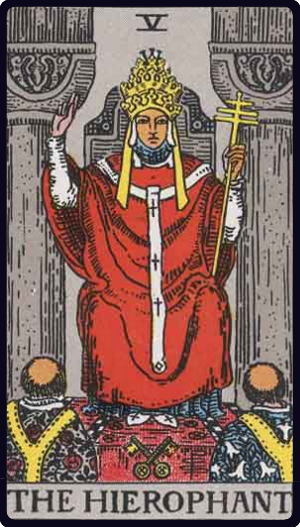
The Hierophant (card 5) — symbolizes tradition, education, spiritual guidance, and conformity. The bridge between divine wisdom and earthly application.
1. About The Hierophant
The Hierophant is card 5 of the Major Arcana. In the Rider-Waite-Smith deck he sits between two grey pillars wearing a triple crown and red robes, his right hand raised in blessing. Two tonsured clergy kneel before him, and a pair of crossed keys lies at his feet. The image is openly religious, and it is the most institutional card in the deck.
Modern readers use the Hierophant to talk about tradition, teaching and belonging: schools, religious communities, professional bodies, family customs, mentors and any shared set of rules. Whether that is comforting or restricting depends on the question.
2. Where The Hierophant Comes From
- Originally "the Pope". In Italian decks the card was Il Papa; in the Tarot de Marseille it was Le Pape. It formed a group of four authority cards with the Popess, Empress and Emperor.
- The renaming. The 18th-century French writer Antoine Court de Gébelin, believing (mistakenly) that tarot had pre-Christian origins, renamed the card "the Hierophant", after the chief priest of the ancient Greek Eleusinian Mysteries. This was part of an attempt to remove the Christian framing from the deck.
- The modern image. Waite and Pamela Colman Smith kept the new name but returned to clearly church-like imagery: the tiara, the keys and the kneeling clergy whose robes carry roses and lilies.
This back-and-forth between "Pope" and "priest of the Mysteries" is a reminder that the card has always been about religious authority, but that readers disagree on which tradition it represents. Today most people read it more broadly as any established body of teaching.
3. Reading the Symbols on the Card
| Symbol | Common reading |
|---|---|
| Triple crown | Authority recognised by a community; often linked to spiritual, intellectual and worldly domains. |
| Raised hand in blessing | Passing on approval, permission or teaching. |
| Crossed keys | Access to knowledge or membership: the "keys" that let you into a tradition. |
| Two kneeling followers | Students or members; learning happens within a relationship. |
| Two pillars | Structure and boundaries, echoing the pillars of the High Priestess but in a public setting. |
4. Upright Meaning by Area of Life
📚 Learning
Formal study, training, apprenticeships and mentors.
🏫 Institutions
Schools, workplaces, religious or civic organisations.
💍 Commitment
Ceremonies, formal agreements and shared values.
🤝 Belonging
Finding a community that shares your beliefs.
| Area | Upright | Reversed |
|---|---|---|
| Love | A conventional, committed relationship; shared values and family expectations. | Pressure to follow a script; questioning traditional relationship models. |
| Work | Established companies, qualifications, following procedure, finding a mentor. | Breaking from the usual path, or friction with rigid rules. |
| Money | Conservative, proven approaches; professional advice. | Unconventional choices that need extra checking. |
| Beliefs | Learning within a tradition or community. | Developing your own views, sometimes in conflict with what you were taught. |
5. The Reversed Hierophant
Reversed, the card is usually read as a tension between personal conviction and the rules of a group. Sometimes that is healthy, for instance outgrowing advice that no longer fits, or questioning a practice that harms people. Sometimes it is reactive: rejecting structure simply because it is structure. Waite's own list for the reversed card was unusually mild ("society, good understanding, concord, over-kindness, weakness"), which shows how much the modern "rebellion" meaning is a later development.
6. Worked Examples
Example 1: Choosing a course
A student unsure whether to take a formal degree or teach themselves draws the Hierophant upright. A reader would typically point toward the structured route, or at least toward finding a teacher, while noting that the card describes a method rather than guaranteeing an outcome.
Example 2: A wedding and family expectations
Someone planning a wedding feels pulled between their own wishes and family traditions. The Hierophant reversed in the "challenge" position would usually be read as that exact tension, and the conversation would turn to which traditions matter to them and which they are keeping only out of obligation.
Example 3: A new job with strict procedures
A person who has just joined a large organisation draws the Hierophant alongside the Eight of Pentacles. The pair suggests learning the system thoroughly first; changes are easier to propose once you understand why the rules exist.
7. Common Card Pairings
- Hierophant + Lovers: a formal commitment, or a choice between personal values and convention.
- Hierophant + High Priestess: outer teaching and inner knowing; the two sides of spiritual learning.
- Hierophant + Emperor: large institutions and established authority.
- Hierophant + Fool: a beginner entering a tradition, or a free spirit uneasy with rules.
8. Common Misunderstandings
- "It is only about religion." Religion is the source of the imagery, but the card applies to any tradition or institution, from universities to trade guilds to family customs.
- "Upright means conformity, which is bad." Shared rules and teachers are how most skills are passed on. The card values that.
- "Reversed always means rebellion is right." It points to a tension, not a verdict. Sometimes the tradition is the wiser option.
- "The Hierophant and the Pope are different cards." They are the same card under different names. Court de Gébelin changed the title in the 18th century.
9. Frequently Asked Questions
❓ Why is it called the Hierophant?
The name comes from the high priest of the Eleusinian Mysteries in ancient Greece. Antoine Court de Gébelin introduced it to replace the older title "the Pope".
❓ Does the Hierophant mean marriage?
Waite's 1910 keywords did begin with "marriage, alliance", and some readers still use it that way. More broadly it describes formal commitments and ceremonies.
❓ Is the Hierophant a good card for exams?
It is commonly linked to study and teachers, so readers often see it as encouragement to follow a structured study plan. It does not predict a result.
❓ What should I do if I keep drawing the Hierophant reversed?
Ask which rule or expectation you are struggling with and whether it still serves you. Writing both sides down can make the choice clearer.
10. Final Thoughts
The Hierophant asks how you relate to the traditions you inherited and the teachers you choose. To place him in context, see our overview of the Major Arcana and the beginner guide. For a question about study or work, try the three-card spread; for relationships see Tarot for Love. These readings are offered for reflection and entertainment.
Sources consulted: Wikipedia, The Hierophant; A. E. Waite, The Pictorial Key to the Tarot (1910).