Temperance Tarot Card Meaning — Balance and Moderation
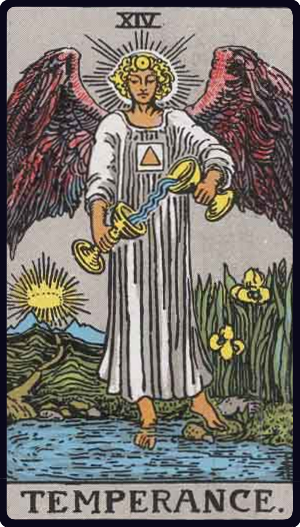
Temperance (card 14) — symbolizes balance, moderation, patience and the careful blending of different elements. It describes an approach to a situation rather than a prediction.
1. About Temperance
Temperance is card 14 of the Major Arcana, and it sits directly after Death. In the Rider-Waite-Smith deck a winged figure, usually described as feminine or androgynous, stands with one foot on dry land and one in a pool of water, pouring liquid from one cup into another. On the figure's chest is a square containing a triangle, with the four-letter Hebrew name of God above it. Behind the figure a path leads toward distant mountains and a glow on the horizon that readers often compare to a crown or sunrise. Irises grow beside the water.
Where Death is about ending, Temperance is usually read as what steadies things afterwards: gradual adjustment, mixing, patience and moderation. It is a quiet card. Nothing dramatic is happening in the picture, and that is exactly the point: this is the card of slow, careful work.
2. Where Temperance Comes From
- A virtue, not a prediction. The card represents temperance as a moral virtue. Traditionally the image is of diluting wine with water, so that it can be enjoyed without excess. Temperance is one of the cardinal virtues, which is why the early tarot designers included it.
- It started with a different number. In the oldest surviving Italian decks the card is numbered VI or VII. In the Tarot de Marseille and most modern decks it is numbered XIV. If you have an older or reconstructed deck and find Temperance in an unfamiliar spot, this is why.
- Sometimes it is called "Art". The Thoth Tarot, and decks influenced by it, rename the card "Art" instead of Temperance, shifting the focus from restraint toward the craft of combining things.
- Astrology. The card is linked with Sagittarius, a mutable fire sign, and with its traditional ruling planet Jupiter.
- Waite's wording. In The Pictorial Key to the Tarot (1910), A. E. Waite gave the upright keywords "economy, moderation, frugality, management, accommodation". These are practical words about managing resources, and they are noticeably more down-to-earth than the "spiritual alchemy" language common today.
3. Reading the Symbols on the Card
| Symbol | Common reading |
|---|---|
| Two cups with liquid passing between them | Mixing and adjusting; a continuous, controlled exchange rather than a single big pour. |
| One foot on land, one in water | Moving between the practical and the emotional; not committing wholly to either. |
| Square and triangle on the chest | Often read as the material and the spiritual combined. The surrounding Hebrew letters are the Tetragrammaton. |
| Wings | A figure that is more than ordinary; guidance, or a higher perspective on the situation. |
| Irises by the water | Readers connect the flower with Iris, the messenger figure of Greek myth, and with the idea of communication between realms. This is an interpretation, not part of Waite's own description. |
| Path to the mountains, glow above them | A long road with a goal in view; progress by steady walking. |
4. Upright Meaning by Area of Life
⚖️ Balance
Giving each part of life its due share.
🧘 Patience
Letting a process take the time it takes.
🎨 Blending
Combining different ingredients, people or ideas.
🌿 Moderation
Avoiding extremes in either direction.
| Area | Upright | Reversed |
|---|---|---|
| Love | Two people adjusting to each other; a relationship built through compromise and steady communication. | Giving too much or too little; mismatched pace; one person pulling toward an extreme. |
| Work | Steady progress, collaboration, a sustainable workload and a sensible pace. | Overcommitting, burnout, or a team pulling in different directions. |
| Money | Budgeting, saving a little regularly, spreading risk. This lines up with Waite's own "economy" and "management". | Overspending or excessive frugality; impatience with slow results. |
| Personal | Finding a routine that keeps energy and attention in proportion. | Swinging between extremes; trying to change everything at once. |
5. Reversed Temperance
Waite's reversed keywords for Temperance were "things connected with churches, religions, sects, the priesthood" along with "disunion, unfortunate combinations, competing interests". The first part reflects the style of his era; modern readers usually take the second part and read the reversed card as imbalance: ingredients that do not blend, goals that compete, or a pace that is too fast or too slow. A useful reversed-card question is "what is being overdone, and what is being neglected?"
6. Worked Examples
Example 1: Juggling study and a job
Someone working full-time while studying draws Temperance as the advice card. A reader would normally talk about pace and proportion, such as a realistic weekly schedule and enough rest, rather than predicting how the course will go.
Example 2: After a falling-out
Two friends who have argued are curious whether things can be repaired. Temperance in the outcome position is usually taken to suggest slow, even-handed repair, with each side giving and receiving, instead of a single dramatic reconciliation. It is a description of a style of approach, not a promise.
Example 3: Reversed, beside the Devil
Temperance reversed next to The Devil is often read as a pull toward excess, such as overspending or overworking, and a loss of the usual balance. The suggested reflection is where moderation has slipped.
7. Temperance in Different Spread Positions
In the past position, Temperance describes a period of adjustment or recovery that shaped the present. In the present, it asks whether you are mixing your commitments in sensible proportion. In the future position it points toward a phase where patience matters more than speed. As an advice card it is one of the gentlest in the deck: slow down, measure, and adjust. You can practise these positions with the free three-card spread.
8. Common Card Pairings
- Temperance + Death: the two sit next to each other in the sequence; readers often see them as an ending followed by gradual recovery.
- Temperance + The Devil: the following card in the sequence; moderation versus excess and attachment.
- Temperance + Justice: two virtue cards; fairness and proportion together.
- Temperance + Strength: patience and self-command; gentle persistence.
- Temperance + The Star: steady, hopeful recovery.
9. Common Misunderstandings
- "Temperance means boring." The card is about proportion, not about removing enjoyment. The classic image is wine and water: both remain in the cup.
- "Temperance only concerns alcohol." The word is older than modern temperance movements. In the tarot it refers to the general virtue of self-moderation.
- "It always means everything will balance out." The card describes an approach and a quality, not a guarantee about how a situation will end.
- "The angel is Archangel Michael." Some modern writers say so, but the deck's creators did not label the figure that way. Treat it as one interpretation among several.
10. Frequently Asked Questions
❓ Why is Temperance number 14?
In the Tarot de Marseille and most modern decks it is card XIV. In some of the oldest Italian decks it was numbered VI or VII, so the number is a matter of deck tradition.
❓ What zodiac sign belongs to Temperance?
Sagittarius and its ruling planet Jupiter are the usual associations.
❓ What did Waite write about Temperance?
Upright: "economy, moderation, frugality, management, accommodation". Reversed: church- and sect-related matters, "disunion, unfortunate combinations, competing interests".
❓ Is Temperance a good card in a love reading?
Readers usually treat it as positive for communication and compromise. It does not say a relationship will last or end. For more on how tarot is applied to relationships, see Tarot for Love.
❓ How is Temperance different from Justice?
Both are virtue cards. Justice is about weighing and deciding fairly; Temperance is about blending and moderating over time.
11. Final Thoughts
Temperance is the card of patient adjustment. If you are new to the deck, the beginner guide explains how single cards fit into a reading, and Major vs Minor Arcana shows where this card sits in the larger structure. Readings are intended for reflection and entertainment and cannot predict life events.
Sources consulted: Wikipedia, Temperance (tarot card); A. E. Waite, The Pictorial Key to the Tarot (1910).