Justice Tarot Card Meaning — Karma, Truth, and Fairness
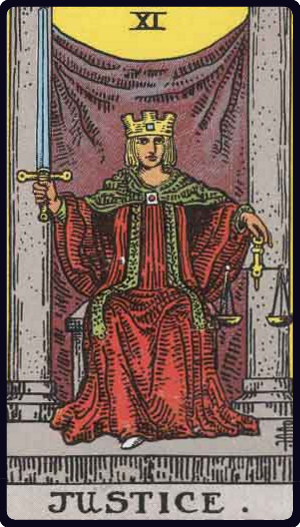
Justice (card 11) — symbolizes fairness, truth, karma, and consequences. What you've sown, you will reap. The scales always balance.
1. About Justice
Justice is card 11 of the Major Arcana in the Rider-Waite-Smith deck. A figure in a red robe sits between two pillars with a purple veil hanging behind. She holds a raised sword upright in her right hand and a pair of golden scales in her left. One white shoe peeks out from under the robe. Unlike the classic statue of Lady Justice, she is not blindfolded; she looks straight ahead.
The card is about fairness, accountability, truth and the consequences of choices. It can refer to literal legal matters, but more often it describes the need to weigh a situation honestly and accept responsibility for your part.
2. Where Justice Comes From
- A cardinal virtue. Justice is one of the four classical cardinal virtues, alongside Fortitude (Strength), Temperance and Prudence. Three of them made it into the tarot trumps.
- Classic iconography. From the earliest decks, the virtue was shown as a crowned woman with a sword and scales, the standard medieval and Renaissance image of justice.
- Number 8 or 11? In the Tarot de Marseille and many older decks, Justice is card VIII. The Golden Dawn assigned Libra, the sign of the scales, to the eleventh position, and the Rider-Waite-Smith deck therefore swapped Justice with Strength. Both numberings are in use today.
Because of the swap, Justice sits in the middle of the Rider-Waite-Smith Major Arcana, right after the Wheel of Fortune. Many readers like this placement: after chance comes accountability.
3. Reading the Symbols on the Card
| Symbol | Common reading |
|---|---|
| Upright sword | Clear, decisive judgement; cutting through confusion. |
| Golden scales | Weighing evidence and both sides of an issue. |
| No blindfold | Seeing clearly rather than judging blindly; awareness of consequences. |
| Two pillars and a veil | A formal setting; justice operating within a structure. |
| White shoe showing | Often read as a sign that the decision will be acted upon; the figure is ready to step forward. |
4. Upright Meaning by Area of Life
⚖ Fairness
Balanced decisions that consider everyone involved.
📜 Accountability
Taking responsibility for your actions.
🔍 Truth
Facts coming to light; honesty being rewarded.
🏛 Formal matters
Contracts, agreements, official decisions.
| Area | Upright | Reversed |
|---|---|---|
| Love | A balanced relationship; honest discussions about fairness. | One-sided effort; blame, or avoiding responsibility. |
| Work | Fair evaluations, contracts, decisions based on merit. | Unfair treatment, bias, or decisions made on incomplete information. |
| Money | Settling debts, clear agreements, paperwork in order. | Disputes, unclear terms, or avoiding a financial reckoning. |
| Personal | Living by your principles. | Self-deception or harsh self-judgement. |
5. Reversed Justice
Waite listed the reversed card as "law in all its departments, legal complications, bigotry, bias, excessive severity". Modern readers often see reversed Justice as something unbalanced: a decision that seems unfair, a refusal to accept responsibility, or a judgement made too harshly. It can be about how you are treated, or about how you are treating someone else. A useful question is "What would a fair outsider say about this?"
6. Worked Examples
Example 1: A workplace dispute
Someone in a disagreement over credit for a project draws Justice upright. A reasonable reading suggests documenting what happened, raising it through proper channels and focusing on facts rather than feelings. The card does not guarantee a ruling in their favour.
Example 2: Sharing chores
A couple asks why they keep arguing about housework. Justice in the advice position points to an honest, balanced conversation about who does what, possibly written down.
Example 3: Reversed, beside the Seven of Swords
In a question about a business partner, reversed Justice with the Seven of Swords would be read as a warning to check agreements and records carefully.
7. Common Card Pairings
- Justice + Emperor: formal authority, rules and legal structure.
- Justice + Judgement: a reckoning or major evaluation.
- Justice + Lovers: a choice that must be fair to both people.
- Justice + Strength: firmness balanced with compassion.
8. Justice Compared with Similar Cards
Three cards in the Major Arcana deal with evaluation and balance, and they are easy to confuse. The table shows how readers usually tell them apart.
| Card | Focus | Typical question it answers |
|---|---|---|
| Justice | Cause and effect; fair decisions in the present | "What is the fair thing to do here, and what is my responsibility?" |
| Judgement | A wake-up call; reviewing the past and answering a calling | "What have I learned, and what am I being called toward?" |
| Temperance | Moderation and blending opposites over time | "How can I bring these extremes into balance?" |
In practice, Justice is the most concrete of the three. It often points to a specific decision, document or conversation, whereas Judgement and Temperance describe longer processes.
9. Common Misunderstandings
- "Justice means I will win my court case." The card describes fairness and process. It cannot predict legal outcomes; for legal issues, consult a qualified lawyer.
- "It is a punishment card." It is about consequences, which can be positive as easily as negative.
- "She is blindfolded like Lady Justice." In the Rider-Waite-Smith deck she is not, and many readers see that as deliberate.
- "Justice is always number 11." Older decks use 8. Neither is wrong.
10. Frequently Asked Questions
❓ What did Waite write about Justice?
"Equity, rightness, probity, executive; triumph of the deserving side in law" upright, and "law in all its departments, legal complications, bigotry, bias, excessive severity" reversed.
❓ Is Justice a yes or no card?
It tends to say "the outcome will reflect what has been done". It is better read as a question about fairness than as a yes or no.
❓ What does Justice mean in a love reading?
Balance and honesty. Reversed, it can point to a relationship where effort or blame is lopsided. See Tarot for Love.
❓ Why was Justice moved to 11?
To match the Golden Dawn's assignment of Libra to the eleventh trump, which the Rider-Waite-Smith deck followed.
11. Final Thoughts
Justice asks for honest weighing and clear decisions. Read it with its neighbour the Wheel of Fortune, or explore a decision with the three-card spread. The career guide covers work disputes and contracts. This page is for reflection and entertainment and is not legal advice.
Sources consulted: Wikipedia, Justice (tarot card); A. E. Waite, The Pictorial Key to the Tarot (1910).