The World Tarot Card Meaning — Completion and Wholeness
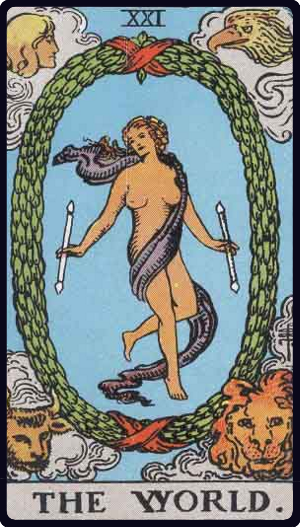
The World (card 21) — symbolizes completion, integration and the end of a cycle, the final step of the Major Arcana before the journey starts again with the Fool.
1. About The World
The World is card 21, the last numbered card of the Major Arcana. In the Rider-Waite-Smith deck a figure, usually read as female, dances or floats inside a large oval wreath, holding a wand in each hand, with a sash wrapped around her. In the four corners are a man (or angel), an eagle, a bull and a lion.
As the final card, the World is usually read as completion, integration and arrival: the end of a cycle, with everything in its place. Its counterpart is the Fool, card 0, so many readers describe the Major Arcana as a journey from the Fool to the World.
2. Where The World Comes From
- Early Italian versions. Fifteenth-century Italian cards show varied images, often a globe or a circular landscape with a walled city, sometimes held up by putti.
- Order varied. In some Italian traditions, such as those of Bologna and Florence, the World came before the Angel (Judgement); in the Marseille ordering Judgement comes first and the World is last.
- Marseille. The Tarot de Marseille shows the dancing figure inside a wreath surrounded by the four creatures. The same arrangement continues in the 1909 Rider-Waite-Smith card.
- The four creatures. They come from Christian art, where they stand for the four evangelists. Occult writers linked them to the fixed signs of the zodiac (Aquarius, Scorpio, Taurus and Leo) and the four elements.
- Other names and letters. In the Thoth Tarot the card is called "The Universe". It is associated with the Hebrew letter Tav, the last letter of the alphabet.
3. Reading the Symbols on the Card
| Symbol | Common reading |
|---|---|
| Dancing figure | Movement within stillness; ease after effort. |
| Oval wreath | Completion and a closed cycle. The wreath is sometimes drawn as an ouroboros. |
| Two wands | Balance between opposites. |
| Four creatures | The four fixed signs and four elements; wholeness. |
| Sash or ribbon | Often read as continuity; the cycle can begin again. |
4. Upright Meaning by Area of Life
🌍 Completion
A cycle reaching its end.
🧩 Integration
Things fitting together.
🎉 Achievement
Recognising what you have done.
✈️ Travel
Waite included "voyage" and "change of place".
| Area | Upright | Reversed |
|---|---|---|
| Love | A relationship reaching a settled, complete stage. | Something unfinished; a stage that has not quite closed. |
| Work | Finishing a major project; reaching a goal. | Delays; loose ends. |
| Money | Closing out a plan or obligation. | A goal not yet reached; stagnation. |
| Personal | Feeling whole; ready for the next chapter. | Feeling stuck just before the finish. |
5. Reversed World
Waite's reversed keywords were "inertia, fixity, stagnation, permanence". Modern readers usually see the reversed World as incompletion: being close to the end but not quite there, or holding on to a stage that is ready to close. The question is what final step is missing.
6. Worked Examples
Example 1: Graduating
A student finishing a degree draws the World. A reader would describe it as the close of a chapter and a moment to recognise the work involved, while the next step is still open.
Example 2: Moving abroad
Someone considering a move overseas draws the World. Because Waite included "voyage" and "change of place", some readers connect it with travel, but the card cannot say whether the move is right; that requires practical planning.
Example 3: Reversed, beside the Hanged Man
The World reversed next to the Hanged Man is often read as a pause just before completion.
7. The World in Different Spread Positions
In the past, the World shows a completed cycle. In the present, it describes arrival or wholeness. In the future, readers see a likely completion; as advice, it suggests finishing what you started. Try it with the Celtic Cross.
8. Common Card Pairings
- World + Fool: the end of one journey and the start of another.
- World + Judgement: reassessment leading to completion.
- World + Sun: a happy, visible achievement.
- World + Chariot: travel and movement.
9. Common Misunderstandings
- "The World means you will travel abroad." Travel is one of Waite's keywords, not a prediction.
- "It is the best card in the deck." It is positive, but completion also means an ending.
- "Completion means nothing more to do." The cycle leads back to the Fool.
- "Reversed means failure." It more often means unfinished.
10. Frequently Asked Questions
❓ What did Waite write about the World?
Upright: "assured success, recompense, voyage, route, emigration, flight, change of place". Reversed: "inertia, fixity, stagnation, permanence".
❓ What are the four figures in the corners?
A man or angel, an eagle, a bull and a lion: the four evangelists in Christian art, later linked to the fixed zodiac signs.
❓ Why is it called The Universe in some decks?
The Thoth Tarot renamed it, and some decks influenced by it followed.
❓ What does the World mean in a love reading?
Often a settled, complete stage. See Tarot for Love.
11. The Fool and the World Compared
The first and last cards of the Major Arcana are often read together, because the World completes the journey the Fool begins.
| The Fool (0) | The World (21) | |
|---|---|---|
| Position | Unnumbered or zero; the start | Last numbered trump; the end |
| Image | A traveller stepping toward a cliff edge | A figure dancing inside a wreath |
| Movement | Setting out without knowing the road | Arriving, with movement held in balance |
| Key idea | Beginning, openness, risk | Completion, integration, closure |
| Reversed (common modern reading) | Recklessness or hesitation | Something left unfinished |
Questions to reflect on when the World appears
- What have I actually completed, and have I recognised it?
- Is there one final step I am avoiding?
- What did this cycle teach me that I want to carry into the next one?
- What would a fresh start, like the Fool's, look like from here?
12. Final Thoughts
The World is the card of completion and of a cycle ready to begin again. To see the whole sequence in context, read Major vs Minor Arcana and the beginner guide. Readings are intended for reflection and entertainment and cannot predict outcomes.
Sources consulted: Wikipedia, The World (tarot card); A. E. Waite, The Pictorial Key to the Tarot (1910).